
Quick Summary
Catastrophic basement flooding creates immediate safety hazards and threatens sub-grade structures with severe microbial growth and material decay if moisture is not mitigated within 24 to 48 hours. Wade's Restoration provides 45-minute emergency dispatch across Midtown West, utilizing industrial extraction units, dehumidifiers, and thermal imaging to remove standing water and eliminate hidden moisture trapped within concrete slabs and structural framing. Property owners can follow critical safety protocols and contact Wade's Restoration's 24/7 live dispatch team for rapid emergency water extraction and a free structural drying assessment.
Flooded Basement Drying: Water Extraction and Moisture Control
When groundwater breaches a foundation or a pressurized water line snaps, flooded basement drying becomes a priority to prevent microbial growth and structural decay. Standing water in below-grade spaces creates immediate safety risks from submerged electrical lines and contaminated runoff. According to CDC and EPA research, drying within 24 to 48 hours is recommended guidance for beginning or completing drying where possible, though it is not a guaranteed completion time. Mold can begin appearing within one to two days, and prompt removal of standing water and thorough drying reduce mold risk. According to specialists at Wade’s Restoration, pumping out water is only the first step, as drying may also require addressing moisture trapped inside concrete slabs, sill plates, and masonry.[1]
Sub-grade structures present specific drying challenges. Basements often feature porous stone, brick, or poured concrete. If extraction and dehumidification are not applied thoroughly, water can remain bound inside these assemblies for weeks, affecting framing and indoor air quality throughout the building above. See also Mold Remediation Nyc | Call Now-10% Off | Same-Day Service | Free Estimate.
Flooded Basement Drying: Emergency Protocol and What to Expect
Flooded Basement Drying in brief: Proper mitigation follows a clear sequence: eliminate electrical hazards, extract bulk standing water, remove non-salvageable porous finishes, and dry the space. Drying time varies with ventilation, temperature, humidity, water depth, materials, and hidden moisture, and some basements can require weeks to dry completely.[2]
Basements do not dry like upper floors. Below grade, there is minimal natural airflow, ambient soil moisture on the exterior of foundation walls, and concrete that holds water. Emergency response protocols focus on removing liquid water first, followed by controlled evaporation to remove trapped moisture.
Immediate Action Checklist for Flooded Basements
- Verify electrical safety before entry: Never step into standing water if electrical outlets, extension cords, or mechanical systems are submerged. Have a licensed electrician or utility crew cut power at the main panel if it cannot be reached safely.
- Identify the water source and category: Clean supply-line breaks require fast drying, while storm runoff or sewer backups carry dangerous pathogens and require bio-washing and strict personal protective equipment.
- Shut off the source: Locate and turn the main water shut-off valve immediately if the flooding stems from an internal plumbing failure.
- Avoid blowing fans across visible mold: Fans and dehumidifiers can speed drying when electrical conditions are safe, but fans should not be used before visible mold has been cleaned because they may spread spores into other areas.
- Consider professional restoration services: Professionals such as Wade’s Restoration may use tools such as extraction systems, air scrubbers, and dehumidifiers to assist in the drying process.
Why Rapid Drying Prevents Secondary Structural Loss
Research from the CDC and EPA provides guidance to begin or complete drying within 24 to 48 hours where possible to reduce mold risk, as mold can begin appearing within one to two days. Prompt removal of standing water and thorough drying help prevent secondary damage to building materials such as drywall, subflooring, and wooden framing.[4]
Concealed Moisture in Below-Grade Spaces
A common issue when drying a basement is assuming the structure is completely dry once surfaces appear dry. Visible dryness may not indicate that concealed materials are dry.
Moisture can remain trapped behind walls, under flooring, or deep inside masonry and concrete slabs even when surfaces feel dry to the touch. If this hidden moisture is not thoroughly addressed, it can lead to mold growth and material deterioration over time.
Flooded Basement Drying Equipment: Moisture Removal Tools
Clearing a flooded basement may involve specialized equipment to remove water and extract moisture from building materials.[5]
Water Extraction Units
Submersible pumps and extraction units help remove standing water from flooded areas, reducing the time building materials remain submerged.
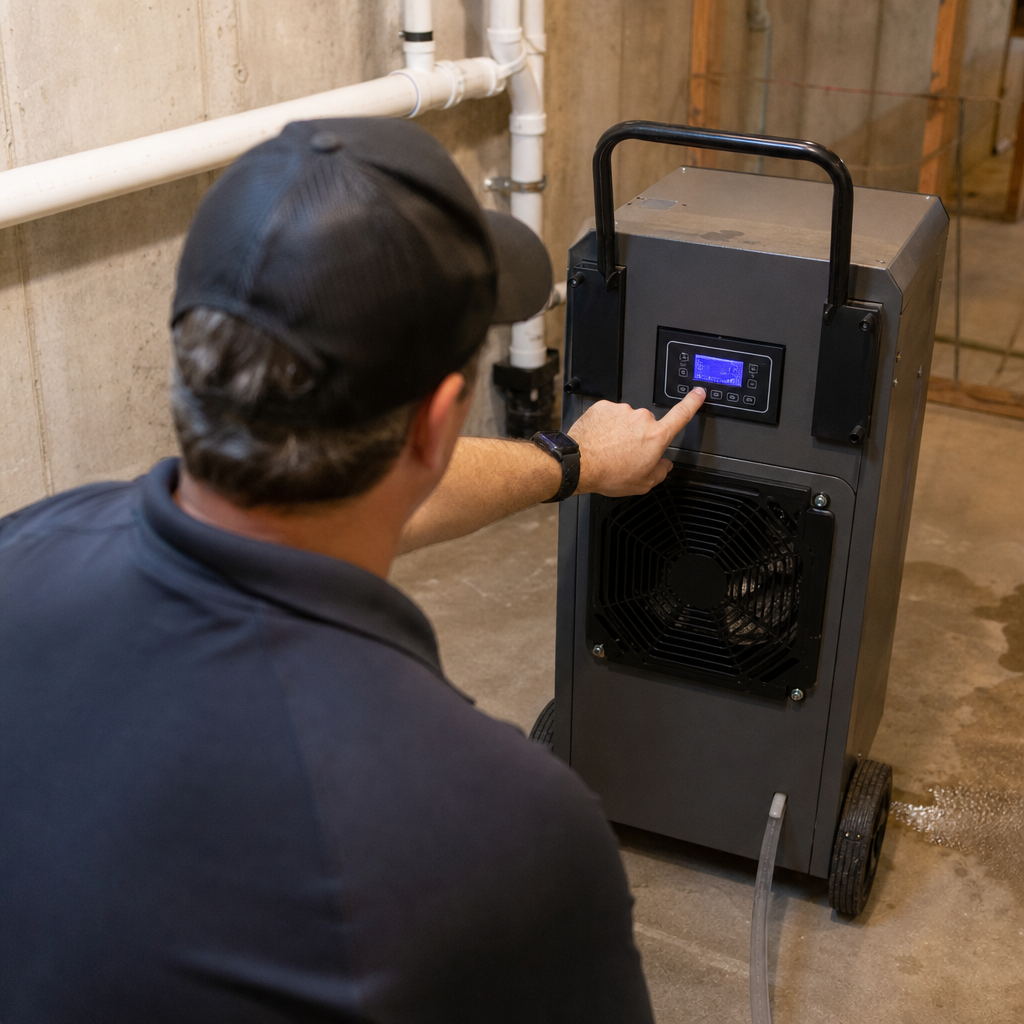
Air Movers and Dehumidifiers
When electrical conditions are safe, air movers and dehumidifiers can speed drying. Air movers circulate air across surfaces, while dehumidifiers capture evaporated moisture from the air. However, fans should not be used before visible mold has been cleaned because they may spread spores.
Step-by-Step Flooded Basement Drying Process
Need flooded basement drying?
We’re available now - call for a fast, free estimate.
Step 1: Emergency Water Extraction and Hazard Mitigation
Safety clearance comes first. Once electrical power is isolated, water extraction units pull standing water from the basement to prevent further water absorption into wall assemblies.
Step 2: Moisture Assessment
Water can spread behind baseboards, under floor plates, and through structural joints. As noted by Wade’s Restoration, moisture meters and thermal imaging tools can be used to assess the migration of moisture and locate damp areas behind finishes and beneath subfloors.
Step 3: Removing Saturated, Non-Salvageable Materials
Porous materials that have absorbed contaminated water or remained wet for extended periods may need to be removed. This can include saturated carpet padding and damaged drywall.
Step 4: Dehumidification and Air Filtration
Dehumidification helps lower indoor moisture levels. Air scrubbers may be used as professional tools to filter airborne particulate matter and dust during the cleanup process.
Step 5: Moisture Monitoring and Documentation
Technicians monitor moisture levels in structural wood framing and concrete throughout the drying process. EPA guidance says materials should generally measure 15% moisture content or less before refinishing.
Basement Structural Components: Subfloors, Framing, and Mechanicals
Restoring a below-grade level requires evaluating components that came into direct contact with water or high humidity:
- Concrete Slabs and Foundation Walls: A clear-plastic moisture test on a concrete slab can be left in place for approximately 16 hours to check for remaining moisture before flooring replacement.
- Sill Plates and Stud Cavities: According to Wade’s Restoration, bottom plates resting directly on concrete absorb moisture and require thorough drying.
- Mechanical Systems: Boilers, water heaters, HVAC ductwork, and electrical equipment submerged in floodwater should be inspected and cleared by qualified professionals before use.
Key Factors Influencing Restoration Timelines
The time and effort required to dry a flooded basement depend on several factors:
- Water Category: Clean water requires different handling than water from sewer backups or outdoor flooding, which requires specialized sanitization.
- Depth and Saturation Duration: Basements that remain saturated take longer to dry. According to FEMA guidelines, if a basement remains wet for a week, hidden portions may require at least another week to dry.
- Extent of Finished Materials: Unfinished basements with exposed concrete generally dry more straightforwardly than finished basements containing drywall, insulation, and custom flooring.
- Drying Conditions: Drying time varies with ventilation, temperature, humidity, water depth, materials, and hidden moisture.
Frequently Asked Questions About Flooded Basement Drying
How do professionals dry out a flooded basement?
Professionals secure electrical safety, pump out standing water, remove non-salvageable materials, sanitize surfaces, and set up air movers and dehumidifiers. They track moisture levels with moisture meters until materials reach acceptable moisture levels.
How long does it take to completely dry a flooded basement?
Drying time varies with ventilation, temperature, humidity, water depth, materials, and hidden moisture, and some basements can require weeks. If a basement remains wet for a week, hidden portions may require at least another week to dry.
Can I dry out a flooded basement on my own?
Minor clean-water incidents can often be managed by property owners if electrical conditions are safe. However, teams like Wade’s Restoration note that significant flooding or contaminated water often benefits from professional equipment and moisture assessment tools to address concealed moisture.
What equipment is used to dry a wet basement after a flood?
Equipment may include submersible pumps, extraction units, air movers, dehumidifiers, air scrubbers, and moisture meters.
How can I prevent mold growth while drying a flooded basement?
Prompt removal of standing water and thorough drying reduce mold risk, as mold can begin appearing within one to two days. Fans and dehumidifiers can speed drying when electrical conditions are safe, but fans should not be used before visible mold has been cleaned because they may spread spores.[3]
What factors influence flooded basement drying costs?
Costs vary depending on the water source category, depth of water, basement square footage, whether the space is finished or unfinished, and the amount of structural drying or material removal required.
Need flooded basement drying?
We’re available now - call for a fast, free estimate.
Sources
- Homeowner’s and renter’s guide to mold cleanup after disasters – stacks.cdc.gov (2012)
- Initial Restoration for Flooded Buildingsarchive.epa.gov › region02 › sandy › web › pdf › fema_flood – archive.epa.gov
- Mold Course Chapter 2: | US EPA – epa.gov
- Mold or Moisture in My Home: What Do I Do? – CDPH – cdph.ca.gov
- After the Storm: Damp, Moldy Homes – climatecentral.org
Related reading: Flood Damage Insurance Claim – 10% Off & Free Estimate – Same-Day Service
Related reading: Mold After Flooding – Call Now-10% Off – Same-Day Service – Free Estimate
Related reading: Mold After Water Leak – 10% Off & Free Estimate – On-Site in 60 Minutes
Frequently Asked Questions
How quickly does emergency water extraction need to begin to prevent permanent basement damage?
Water extraction should begin within 24 to 48 hours to prevent toxic mold proliferation and structural decay in framing and subfloors. Wade's Restoration provides 45-minute emergency dispatch across Midtown West to immediately extract bulk water and stabilize sub-grade environments.
How do specialists detect hidden moisture trapped within concrete slabs and finished walls?
Technicians utilize non-invasive thermal imaging cameras and structural moisture meters to detect dampness migrating behind baseboards, sill plates, and concrete masonry. Wade's Restoration continuously tracks these readings to ensure framing reaches safe moisture levels of 15% or less before completing the project.
What additional drying steps are required if basement floodwater involves sewage or storm runoff?
Contaminated floodwater requires strict containment, bio-washing, and the immediate disposal of saturated porous materials like drywall and carpet padding. Technicians deploy industrial air scrubbers alongside commercial dehumidifiers to eliminate airborne contaminants and pathogens throughout the structural drying process.
About the author
 |
Sarah Jenkins Sarah Jenkins is a certified property restoration specialist with over 8 years of experience in water damage mitigation and mold remediation. Based in New York, she focuses on helping Midtown West property owners navigate emergency cleanups and complex insurance claims. She holds a degree in Environmental Science from Rutgers University. |
Water damage, flood, or mold emergency?
We’re available now - call for a fast, free estimate.
Call Now - Free Estimate