
Quick Summary
Following indoor plumbing failures or moisture intrusion, addressing mold after water leak events within the critical 24-to-48-hour window is essential to prevent rapid fungal colonization and property damage. Wade's Restoration emphasizes that immediately stopping the water source, executing precision drying, and removing saturated porous materials are the most effective steps to stop toxic wall growth. Readers will learn how to identify hidden moisture indicators, execute immediate response protocols, and coordinate professional containment to protect indoor air quality.
Mold After a Water Leak: Dry Wet Materials Within 24 to 48 Hours
When managing mold after water leak events, timing is critical. Drying wet or damp materials within 24 to 48 hours can reduce the likelihood of mold growth; the EPA says mold will not grow in most cases when materials are dried within that period.
Plumbing failures are common. Data from the 2019 American Housing Survey indicates that 7.6% of U.S. homes experienced water leakage from interior sources, while 9.4% reported exterior water penetration. Published estimates across building studies show that between 10% and 50% of indoor spaces suffer from dampness or mold issues.[2] See also Mold Remediation Nyc | Call Now-10% Off | Same-Day Service | Free Estimate.
How Fast Does Mold Grow After a Water Leak?
The U.S. Environmental Protection Agency (EPA) emphasizes the 24-to-48-hour response window to prevent mold growth on building materials. If materials remain wet past 48 hours and mold after water leak issues develop, building assemblies require prompt containment, professional assessment, and structured remediation guidance.[5]
Recommended 24-to-48-Hour Response Steps
- Stop the leak: Turn off the water supply or stop the source of water intrusion.
- Remove water: Promptly remove standing water from affected areas.
- Dry affected materials: Thoroughly dry wet and damp materials within 24 to 48 hours.
Signs of Hidden Mold
Potential warning signs of hidden mold include:
- Persistent musty odors.
- Rippling wall coverings.
- Cracked drywall tape.
- Peeling paint.
- Unexplained water damage.
Moisture and Building Studies
In a study of 831 U.S. homes across 75 locations, moisture or mold problems were found in 24% of surveyed homes.[3]
Affected Building Materials: Assessment and Cleanup
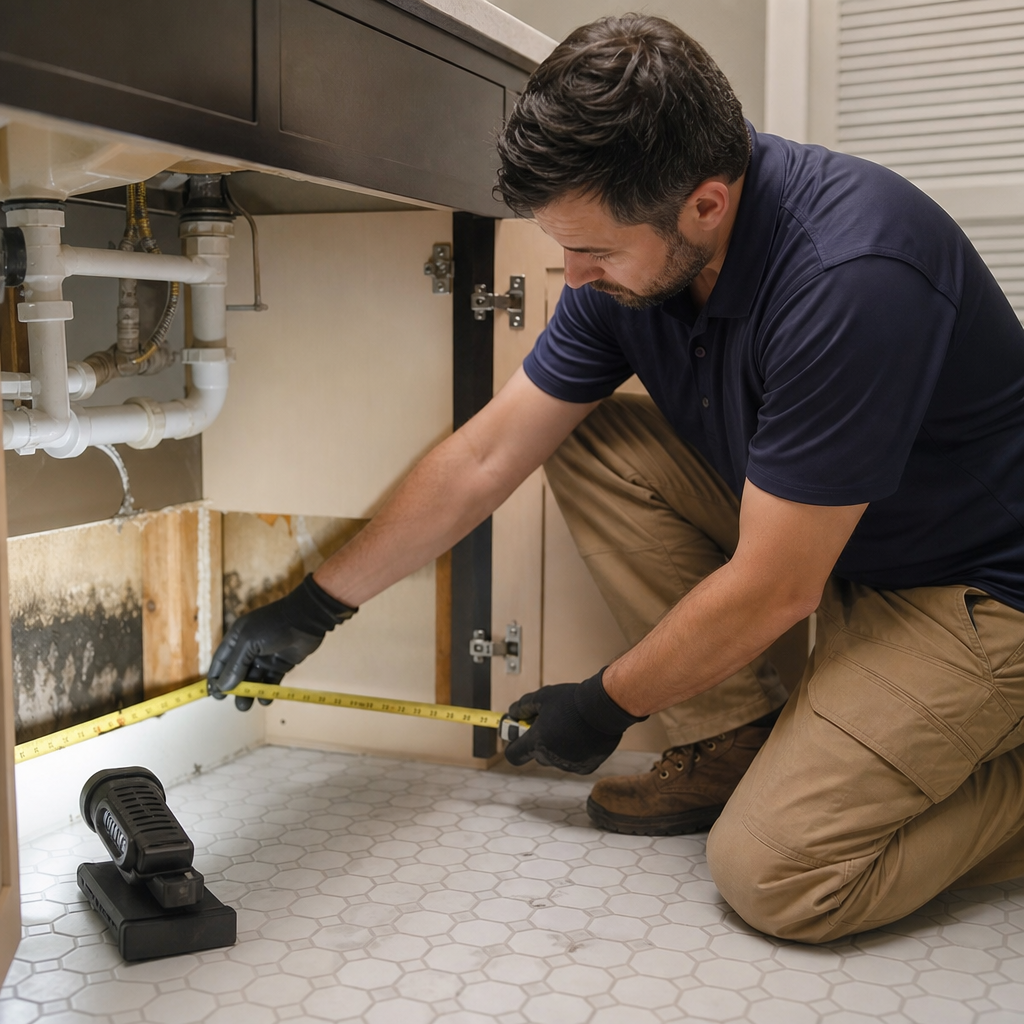
A building study published by the CDC showed that water-damaged buildings had higher odds of visible mold and mold odor.[1]
For cleanup, saturated drywall and carpet padding usually require prompt disposal, while structural wood framing and hard surfaces can be cleaned, disinfected, and dried following EPA guidance.
Insurance Considerations
To navigate insurance claims, thoroughly photograph all water damage, keep detailed repair logs for the adjuster, and verify if your policy covers sudden water events like burst pipes.
Frequently Asked Questions About Post-Leak Mold
How quickly should drying begin after a leak?
Drying wet or damp materials within 24 to 48 hours can reduce the likelihood of mold growth; the EPA says mold will not grow in most cases when materials are dried within that period.
What health symptoms can appear after a building leak?
Indoor dampness and mold growth can trigger respiratory symptoms, nasal congestion, eye irritation, persistent coughing, throat irritation, and heightened asthma attacks, especially in sensitive individuals.[4]
Is testing required before mold remediation begins?
When visible mold growth or clear water damage is present, formal sampling and lab testing are usually unnecessary. According to Wade’s Restoration, the focus should be on stopping the moisture source and addressing the affected materials.
Need mold after water leak?
We’re available now - call for a fast, free estimate.
Sources
- Association of exposure to indoor molds and dampness … – PMC – pmc.ncbi.nlm.nih.gov (2024)
- NIOSH Dampness and Mold Assessment Tool (DMAT) – PMC – pmc.ncbi.nlm.nih.gov (2019)
- Prevalence of Building Dampness – Indoor Air – iaqscience.lbl.gov (2009)
- A Spreading Concern: Inhalational Health Effects of Mold – PMC – pmc.ncbi.nlm.nih.gov (2007)
- PREVALENCE OF POTENTIAL SOURCES OF INDOOR AIR – epa.gov
Related reading: Mold After Flooding – Call Now-10% Off – Same-Day Service – Free Estimate
Related reading: Flood Damage Insurance Claim – 10% Off & Free Estimate – Same-Day Service
Related reading: Basement Water Damage Cleanup | Call Now-10% Off | Same-Day Service | Free Estimate
Frequently Asked Questions
How do professionals detect hidden mold inside walls after a water leak?
Even if drywall appears dry on the outside, moisture can remain trapped inside wall cavities. Wade's Restoration utilizes precision moisture mapping and infrared thermal imaging to identify hidden dampness and structural fungal growth without unnecessary demolition.
How can you prevent mold spores from spreading to other rooms during cleanup?
Professional remediation requires establishing physical poly-sheeting barriers and using HEPA-filtered negative air machines to capture airborne particles. Wade's Restoration applies strict IICRC-certified containment protocols to isolate contaminated areas and prevent cross-contamination across residential and commercial properties.
What should you do if a water leak was left wet for more than 48 hours?
Because fungal colonization accelerates rapidly past the 48-hour mark, saturated porous materials like drywall and insulation typically require safe removal under controlled conditions. Contact the 24/7 emergency dispatch team at Wade's Restoration to schedule a free visual inspection and initiate rapid containment procedures.
About the author
 |
Marcus Avery Marcus Avery is an IICRC-certified restoration specialist with over 12 years of experience in structural drying and water damage mitigation. Holding a B.S. in Construction Management from the Wentworth Institute of Technology, he frequently consults with property management firms in the tri-state area on emergency response planning. Marcus specializes in helping Midtown West property owners navigate complex water damage scenarios and detailed restoration cost analysis. |
Water damage, flood, or mold emergency?
We’re available now - call for a fast, free estimate.
Call Now - Free Estimate