
Quick Summary
Sub-grade flooding demands immediate basement water damage cleanup within 24 to 48 hours to halt structural decay, salvage building assemblies, and prevent dangerous mold growth. Wade's Restoration delivers prompt emergency water extraction, industrial dehumidification, and precise moisture mapping across Midtown West to thoroughly dry concrete slabs and interior framing while simplifying insurance claims. Property owners will understand the four-phase restoration protocol, critical cost factors, and how to contact Wade's Restoration for 24/7 emergency basement extraction and a free on-site inspection.
Basement Water Damage Cleanup: Fast Emergency Restoration
When standing water enters a lower level, immediate basement water damage cleanup is essential to prevent permanent structural loss. Wade’s Restoration provides water extraction and structural drying throughout Midtown West and across New York City. We respond promptly to help stop moisture from spreading before restoration costs escalate toward a major insurance loss.
Whether you manage a commercial property in Hudson Yards or own a brownstone in Hell’s Kitchen, sub-grade water intrusion poses significant challenges. Water saturates porous slab concrete, weakens framing, and can trigger mold growth within 24 to 48 hours. In dense urban architecture, standing water can quickly damage porous materials and spread dampness through lower levels. Professional restoration technicians use specialized equipment designed for complex properties, handling moisture mapping and documentation for insurance claims. Contact our local team for emergency water removal and an on-site visual assessment.
Emergency Basement Water Damage Cleanup: Immediate Action and Response
Emergency Basement Water Damage Cleanup Summary: Professional mitigation requires prompt water extraction, structural dehumidification, sanitization, and controlled repair. Taking action within the first 24 to 48 hours protects structural materials, keeps salvageable framing intact, and helps prevent mold spores from spreading. Restoration teams use commercial extraction units and low-grain refrigerant (LGR) dehumidifiers to return structural assemblies to dry standard baselines.
Sub-grade flooding requires prompt stabilization. In multi-unit buildings, standing basement water can increase humidity levels and allow moisture to migrate into surrounding structural assemblies. Quick, controlled water removal relieves excess moisture and keeps localized seepage from causing broader property damage.
What to Do Immediately When Your Basement Floods
- Isolate power and utilities safely: Never step into standing water. Shut off main electrical breakers and gas supply lines from a completely dry location first.
- Contact a restoration team: Call professional flooded basement cleanup services right away to deploy water mitigation equipment, submersible pumps, and cleanup crews to handle the damage.
- Document water levels and damage: Capture clear, room-by-room photos and video of standing water, damaged equipment, baseboards, and personal property before moving items around. This evidence is helpful for your insurance adjuster.
The 24 to 48 Hour Mold and Structural Window
Mold can begin to grow within 24 to 48 hours after water exposure if wet materials are not dried promptly. When water sits beneath a building, moisture wicks upward into porous drywall, structural timber, and plaster. This hidden dampness often creates the need for extensive mold remediation across multiple areas.
The Federal Emergency Management Agency (FEMA) recommends using flood-damage-resistant materials for all sub-grade interiors and raising critical mechanical and electrical components above anticipated flood elevations. Technical guidance issued by FEMA following Hurricane Ida also outlines structural measures, such as reinforcing basement walls and elevating main boilers, to prevent structural collapse under external soil saturation. In dense urban neighborhoods, the New York Fed reports that approximately 10% of low-income and immigrant New Yorkers live in census tracts with high concentrations of basement apartments at high risk of flooding, making fast response and proper drainage systems a public safety priority.[2]
How Much Does Basement Water Damage Cleanup Cost?
Need basement water damage cleanup?
We’re available now - call for a fast, free estimate.
Basement water damage cleanup costs vary depending on the extent of flooding, contamination levels, and whether the space is finished or unfinished. Smaller to moderate basement cleanup jobs often run about $1,500 to $5,000, while costs can be higher for finished basements or extensive Category 3 sewage backups. Final pricing depends on water categories, structural materials, and required drying equipment. Contact us for an accurate, on-site written estimate.[1]
Cost Factors: Water Categories and Structural Materials
Restoration expenses depend on the category of water involved:
- Category 1 (Clean Water): Originates from broken supply pipes or clean sink overflows. Materials are generally easier to salvage if addressed immediately.
- Category 2 (Grey Water): Comes from washing machines, dishwashers, or sump pump failures. It carries biological residues and requires targeted antimicrobial cleaning.
- Category 3 (Black Water): Involves municipal sewer backups or street runoff. This requires full biohazard containment, removal of porous assemblies, and heavy sanitization.
| Restoration Service | Estimated Cost Range |
|---|---|
| On-Site Inspection & Moisture Mapping | $150 – $500 |
| Minor to Moderate Basement Cleanup & Drying | $1,500 – $5,000 |
| Black Mold Remediation and Air Scrubbing | $1,500 – $6,000 |
| Category 3 Sewage Backup Cleanup | $2,000 – $10,000+ |
| Finished Basement / Extensive Restoration | $5,000 – $15,000+ |
Handling Insurance Claims and Documentation
Standard property policies may cover sudden internal pipe bursts, though insurance coverage depends on policy terms and proper documentation. Wade’s Restoration assists throughout the process by recording moisture readings, documenting damage, and providing itemized estimates to share with your insurance adjuster.
Repair vs. Replace: Managing Critical Basement Building Systems
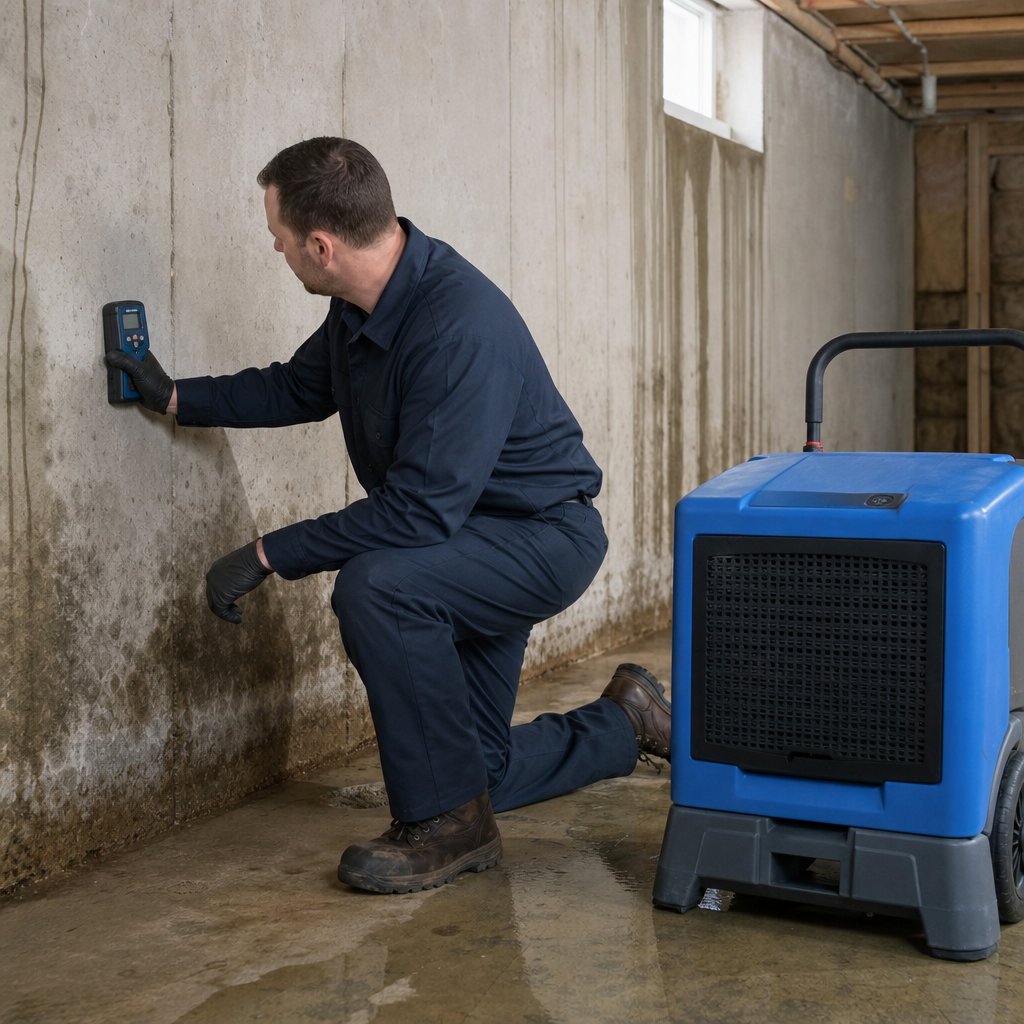
Determining whether materials can be dried in place or must be torn out depends on water contamination, material porosity, and structural load requirements. Poured concrete slabs and heavy structural beams can often be saved, but submerged insulation and porous wall coverings usually require removal.
Foundation Walls, Slabs, and Structural Joists
Drying basement structures requires proper moisture management. Technicians at Wade’s Restoration use commercial dehumidifiers and calibrated moisture meters to gradually dry sub-grade concrete, masonry, and framing timber to return materials to safe moisture levels.
Drywall, Plaster, and Shared Chases
For clean water events, specialized wall-cavity drying systems can push dry air behind drywall and plaster without major demolition. However, during contaminated flood events, technicians must execute precise flood cuts 12 to 24 inches above the water line. Opening these wall cavities allows airflow into wet framing and prevents trapped moisture from causing hidden mold growth.
Electrical Risers, Boilers, and HVAC Systems
Mechanical rooms in subterranean spaces require strict attention to satisfy municipal building codes:
- Electrical panels and wiring: Power is cut immediately. Panels exposed to water are inspected for internal corrosion, and saturated breakers are replaced.
- Boilers and water heaters: Technicians inspect combustion chambers, replace saturated insulation jackets, and test pressure relief valves.
- HVAC ductwork: Wet porous duct liners are removed and discarded, while rigid metal supply lines are cleaned, disinfected, and dried under negative air pressure.
Choosing a Restoration Partner: Certified Specialists vs. General Contractors
Need basement water damage cleanup?
We’re available now - call for a fast, free estimate.
Professional restoration companies utilize commercial water-extraction units, calibrated drying meters, and HEPA filtration to address water intrusion effectively.
| Feature | Wade’s Restoration | General Handymen | National Call Centers |
|---|---|---|---|
| Response Time | Local NYC response | Subject to availability | Variable routing queues |
| Containment Protocols | HEPA-filtered containment | Often uncontained | Depends on subcontractor |
| Structural Care | Calibrated structural drying | Basic fan drying | Standard bulk air movers |
| Insurance Documentation | Detailed logs and itemized billing | Handwritten receipts | Third-party coordination |
Preventing Cross-Contamination During Demolition
Tearing out wet drywall or flooring without proper containment can spread fine particulate matter, bacteria, and mold spores. Professional crews establish sealed polyethylene containment zones and use negative air machines to help maintain indoor air quality during remediation.
The Step-by-Step Basement Water Damage Restoration Process
Our restoration protocol follows a proven four-phase sequence to protect structural integrity and prevent mold development.
Step 1: Rapid Water Extraction
Technicians deploy submersible pumps and commercial extraction units to remove standing water from concrete slabs and flooring surfaces.
Step 2: Thermal Moisture Mapping and Containment
Using thermal imaging cameras and non-penetrating moisture meters, our team maps the full path of water migration inside walls and subfloors. We seal the work zone with negative air scrubbers to trap airborne dust and microbial spores.
Step 3: Industrial Dehumidification and Structural Drying
We install industrial low-grain refrigerant (LGR) dehumidifiers and high-velocity axial air movers. These units pull trapped water from concrete, sill plates, and subfloors, bringing structural materials back to target moisture levels.
Step 4: Sanitization, Mold Prevention, and Full Reconstruction
Surfaces are treated with EPA-registered antimicrobials to prevent mold growth. Once drying goals are verified on our daily moisture logs, our reconstruction team replaces drywall, framing, insulation, and finished flooring to return your property to its pre-loss condition.
Frequently Asked Questions
How much does basement water damage cleanup cost?
Smaller to moderate basement cleanup jobs often run about $1,500 to $5,000, while costs can be higher for finished basements or extensive Category 3 sewage contamination. Pricing depends on water category, square footage, and required structural drying.[3]
What should I do immediately when my basement floods?
First, stay out of standing water and turn off electricity and gas from a dry, safe location. Take clear photos and videos of the damage for insurance purposes, and then call a professional water mitigation company right away.
How long does it take to completely dry out a flooded basement?
Drying time depends on the extent of water intrusion and the materials affected. Minor jobs may dry in a few days, while heavily flooded basements or dense materials like concrete slabs can take a week or more with commercial dehumidifiers.
Does homeowners or commercial insurance cover basement water damage?
Standard property insurance policies may cover sudden, accidental internal water damage, such as a burst supply pipe or water heater failure, depending on individual policy terms. Water entering from outdoor flooding or sewer backups typically requires dedicated flood insurance or specific endorsements.
Can I clean up flooded basement water myself or should I call a professional?
Household shop vacuums and standard fans cannot extract water trapped deep inside concrete slabs, sill plates, and wall cavities. Leaving hidden moisture behind leads to structural rot and mold growth within 24 to 48 hours. Professional restoration teams have the extraction power, thermal tools, and drying equipment to eliminate moisture completely.
How do restoration companies prevent mold growth after basement water damage?
Crews prevent mold by rapidly extracting bulk water, setting up negative-air containment to stop spore distribution, applying EPA-registered antimicrobial solutions to framing, and running commercial dehumidifiers until materials reach industry dry standards.
Contact Wade’s Restoration today for commercial water damage mitigation, flooded basement cleanup services, and an on-site visual assessment.
Need basement water damage cleanup?
We’re available now - call for a fast, free estimate.
Sources
- Building Performance: – fema.gov (2022)
- P-2333 New York City: Effects of Hurricane Ida – fema.gov (2022)
- Bringing Basement Apartments Into the Light – comptroller.nyc.gov
Frequently Asked Questions
How quickly can Wade's Restoration respond to an emergency basement flood in Midtown West?
Wade's Restoration provides a rapid 45-minute emergency response across Midtown West and NYC to begin immediate water extraction and structural stabilization. Rapid deployment within the initial 24 to 48 hours halts upward moisture wicking and protects sub-grade concrete and framing from severe structural decay.
How does Wade's Restoration help property owners navigate insurance claims for basement water damage?
Through our proprietary Claim Clarity Program, our technicians capture thermal moisture mapping data, record drying logs, and provide fully itemized estimates to share with your adjuster. This comprehensive documentation substantiates covered perils, such as sudden pipe bursts, and helps streamline insurance claim approvals.
When does basement drywall require flood cuts instead of in-place drying?
Flood cuts are required 12 to 24 inches above the moisture line if the intrusion involves Category 2 grey water, Category 3 sewage, or wet porous insulation inside wall cavities. Wade's Restoration sets up HEPA-filtered containment zones before performing precision cuts to ventilate structural wall framing and prevent mold cross-contamination.
About the author
 |
Marcus Avery Marcus Avery is an IICRC-certified restoration specialist with over 12 years of experience in structural drying and water damage mitigation. Holding a B.S. in Construction Management from the Wentworth Institute of Technology, he frequently consults with property management firms in the tri-state area on emergency response planning. Marcus specializes in helping Midtown West property owners navigate complex water damage scenarios and detailed restoration cost analysis. |
Water damage, flood, or mold emergency?
We’re available now - call for a fast, free estimate.
Call Now - Free Estimate