
Quick Summary
Severe water emergencies across New York City properties often trigger complex claim disputes and heavy out-of-pocket costs that stall essential structural drying. Through its Claim Clarity Program, Wade's Restoration delivers rapid emergency mitigation and provides water damage direct insurance billing in NYC by submitting comprehensive moisture logs straight to insurance carriers. Property owners will understand how direct billing resolves co-op master policy splits and can contact the 24/7 dispatch line to start immediate mitigation without upfront invoice burdens on covered claims.
Water Damage Direct Insurance Billing NYC – Fast Response
When clean water, grey water, or sewage floods a property in Manhattan, the immediate concern is stopping the spread, but the financial headache begins immediately after. For property managers, co-op shareholders, and homeowners dealing with sudden pipe bursts or roof failures, Wade’s Restoration provides water damage direct insurance billing nyc services. Our IICRC-certified crews respond promptly, dry the structure properly, and submit line-item documentation directly to your insurance company. On covered claims, direct billing may help reduce upfront payment burdens, though policyholders remain responsible for policy deductibles, non-covered items, or any out-of-pocket costs exceeding policy limits.
With thousands of flood and water claims filed across New York City every year, claims often get delayed because of incomplete paperwork or confusion over who pays for what. Through our Claim Clarity Program, our team takes over technical documentation upon arrival. We capture detailed thermal imaging, log daily psychrometric drying readings, and build itemized estimates so your carrier receives the documentation needed to evaluate the claim.[1] See also Commercial Water Damage Restoration | 10% Off & Free Estimate | Same-Day Service.
How Water Damage Direct Insurance Billing Works
How direct billing works in brief: Instead of requiring you to pay the entire mitigation invoice upfront and seek reimbursement later, a direct-billing restoration contractor bills your insurance carrier directly for emergency water extraction, drying, and structural stabilization. The contractor supplies the carrier with moisture logs, line-item pricing, and photographic proof. Direct billing may help reduce your upfront payment burden, while you remain responsible for your policy deductible and any uncovered costs.
In standard direct billing, the restoration company acts as the technical liaison between your property and the adjuster. Once you file your initial claim and receive a claim number, our technicians step in to handle the mitigation documentation. We track water migration with moisture meters, calculate the drying equipment needed under industry standards, and submit the itemized estimate straight to your carrier’s claims department.[4]
What Direct Billing Covers For NYC Property Owners
Direct billing generally applies to emergency water mitigation services that prevent further structural decay. This includes:
- Standing water extraction from floors, basements, and elevator pits
- Commercial dehumidification and targeted structural drying
- Antimicrobial treatments to prevent mold growth
- Controlled removal of saturated materials like drywall, trim, and ruined carpet
- Daily moisture monitoring and adjuster reporting
According to the NYC Hazard Mitigation Plan, the city has recorded nearly 36,550 flood-related insurance claims over the past several decades. In dense urban buildings, minor pipe leaks often cross multiple apartments, making accurate documentation critical for ensuring insurance adjusters evaluate every step of the emergency work.[5]
Key Benefits: Immediate Mitigation And Coordinated Claims
The biggest risk during an active water leak is delay. The longer water sits in pre-war plaster, subflooring, or drywall assemblies, the higher the risk of permanent warping, rot, and mold growth. Direct billing can help facilitate prompt mitigation work, allowing technicians to set up air movers and dehumidifiers without unnecessary delays. Restoration contractors like Wade’s Restoration can work directly with major national and regional carriers to help keep claims moving forward smoothly.
NYC Co-Op And Condo Direct Billing: Navigating Master Policies Vs. HO-6 Claims
Need water damage direct insurance billing nyc?
We’re available now - call for a fast, free estimate.
Direct insurance billing in New York City co-ops and condominiums differs significantly from single-family homes. Allocating restoration charges between a unit owner’s personal HO-6 policy and a building’s commercial master policy requires careful review, as billing mistakes can lead to denied charges and unexpected balance disputes.
The Jurisdictional Boundary Line Between HOA Master Policies And Unit Owners
In high-rise condos and pre-war co-ops, exact responsibility is governed by the building’s proprietary lease, declarations, or bylaws. Generally, building master policies tend to cover common structural components, primary plumbing risers, and original demising walls, while individual HO-6 policies typically address personal property, custom fixtures, cabinetry, and interior finishes. However, specific coverage divisions depend entirely on the building’s governing documents and individual policy terms.[3]
| Building Element & Service | Building Master Policy | Individual HO-6 Rider | Split Direct Billing Approach |
|---|---|---|---|
| Main plumbing risers & common structural components | Typically covered (subject to bylaws) | Typically excluded | Billed to building commercial carrier where applicable |
| Custom cabinetry, interior finishes & unit owner furnishings | Typically excluded | Typically covered (subject to policy) | Billed to unit owner HO-6 carrier where applicable |
| Demolition & structural drying across shared walls | Shared or master (per bylaws) | Unit finishes only (per bylaws) | Split into separate scopes based on governing documents |
| Risk of out-of-pocket balance billing | High if misallocated | High if misallocated | Minimized by reviewing jurisdictional lines prior to billing |
How Split Scopes Help Prevent Disputed Balances
To help protect both building boards and individual unit owners from disputed balances, restoration contractors can write split scopes based on building bylaws. Technicians document the origin of the leak, identify which materials pertain to the building versus the shareholder or unit owner, and compile separate, clearly defined claim packages. This structure allows each insurance adjuster to review charges relevant to their policy terms.
Emergency Water Damage Restoration For Drywall, Ceilings, And Plaster
Water mitigation requires rapid action within the first 24 to 48 hours. Saturated building assemblies weaken under hydrostatic pressure, and microbial amplification can begin within two days under typical indoor humidity levels.[2]
Identifying Water Trapped In Pre-War Plaster Vs. Modern Drywall
Midtown West contains a distinct mix of historic brownstones, pre-war walk-ups, and modern glass high-rises. Each responds differently to water:
- Modern Drywall: Gypsum board acts like a sponge. When water pools behind baseboards, moisture wicks upward quickly. In these cases, clean cuts 12 inches above the water line may be necessary to expose wall cavities and remove wet fiberglass insulation.
- Pre-War Plaster and Lath: Historic horsehair plaster is dense and can hold moisture without showing immediate swelling. If mismanaged, heavy plaster ceilings can fail unexpectedly. Rather than removing historic walls prematurely, non-invasive thermal imaging and specialized dehumidification systems are used to dry plaster in place whenever structurally safe.
Repair Vs. Replace Decision Criteria To Prevent Mold Growth
Data from the NYC Hazard Mitigation Plan notes that thousands of local properties have suffered repetitive water damage. Preventing repeat problems means knowing when to salvage materials and when to discard them:
- Stabilization and Drying: Intact plaster with sound lath backing and solid subfloors that show no signs of delamination are dried under controlled airflow and continuous humidity monitoring.
- Controlled Removal: Saturated drywall, contaminated acoustic tiles, and compromised insulation are removed under negative air pressure to help prevent particulate spread through building areas.
Restoring Saturated Hardwood Floors And Structural Subflooring
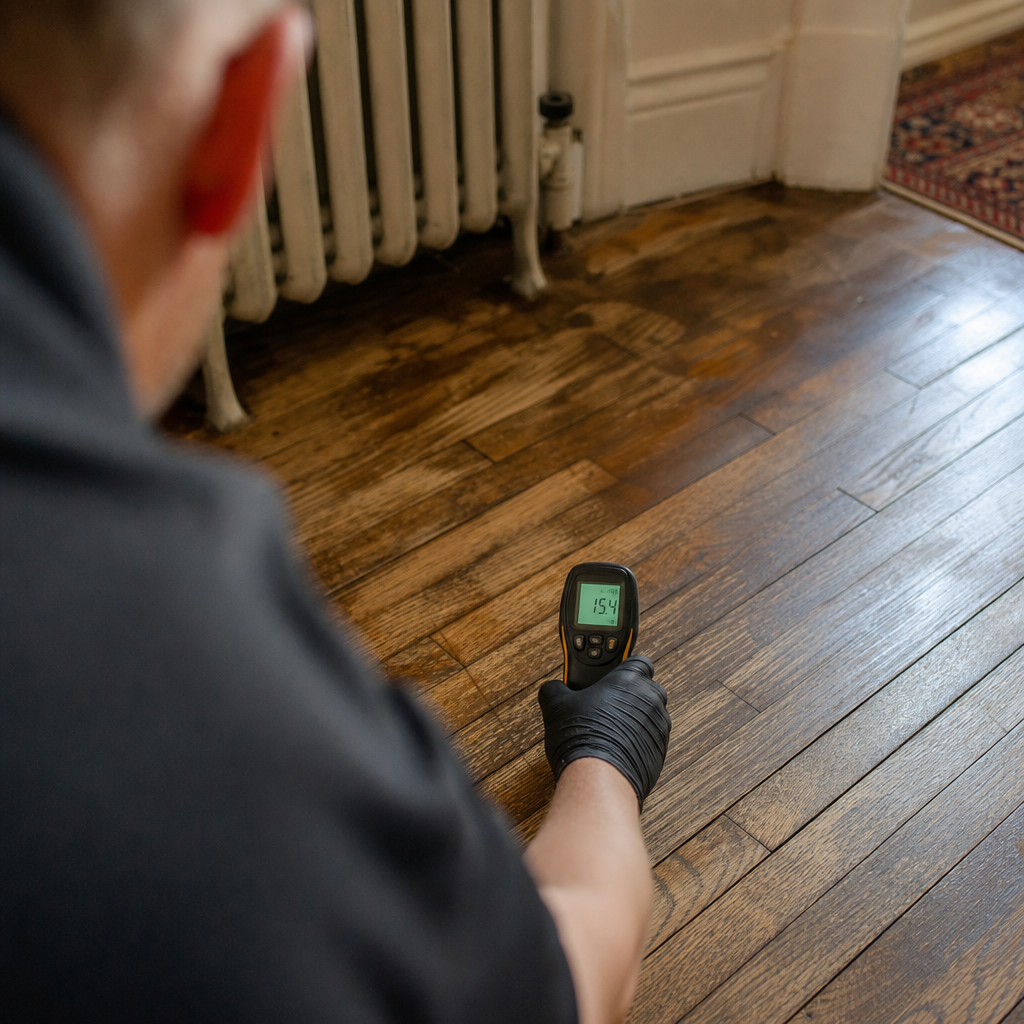
When water seeps into hardwood floors, the boards expand against each other, leading to cupping (edges higher than the center) or crowning (center bulging upward). Left untreated, moisture migrates into the underlying subfloor, potentially causing material degradation or adhesive failure.
Managing Cupping, Crowning, And Subfloor Delamination
Replacing hardwood flooring in an apartment can be costly and disruptive. To save salvageable wood, restoration teams like Wade’s Restoration utilize specialized floor-mat extraction systems. These vacuum panels seal over wet boards to draw moisture out of the wood grain and subfloor beneath. Combined with commercial dehumidifiers, this process can often restore cupped boards to a flat state without requiring complete floor replacement.
Handling Contaminated Water And Sewage Backup Cleanup
Not all water is clean. Sewer backups, toilet overflows, and contaminated runoff carry harmful pathogens classified as Category 3 black water. In these situations, porous materials like carpet padding and waterlogged trim cannot simply be dried; they must be removed and properly discarded. Technicians establish containment, extract standing sewage, and treat exposed framing with EPA-registered antimicrobials before structural drying begins.
What Does Water Damage Direct Insurance Billing NYC Cost?
Need water damage direct insurance billing nyc?
We’re available now - call for a fast, free estimate.
Water mitigation costs in New York City vary widely depending on the square footage, category of water, materials affected, and building layout. When working with a direct-billing restoration contractor, emergency mitigation costs are submitted straight to your insurance carrier using itemized, standardized pricing schedules.
Cost Considerations By Restoration Service
Exact mitigation costs depend on project specifics, but direct billing typically applies to the following operational phases:
- Emergency Water Extraction & Pumping: Costs vary based on standing water volume, accessibility, and extraction equipment required.
- Dehumidification & Structural Drying: Dependent on the number of air movers, dehumidifiers, and monitoring days needed to reach dry standards.
- Sewage & Black Water Remediation: Involves biohazard containment, specialized disposal, and antimicrobial treatments.
- Structural Repairs & Rebuild: Subject to specific policy limits and allocated between master policy and HO-6 scopes according to building bylaws.
Understanding Deductibles And Out-Of-Pocket Limits
While direct billing can significantly reduce upfront payment burdens, policyholders remain responsible for their policy deductible and any non-covered expenses or policy limit shortfalls. In multi-unit buildings, policyholders should also verify whether their coverage includes water backup endorsements, as standard policies may limit coverage for sewer or drain backups unless specifically added.
How To Choose A Water Damage Restoration Partner That Bills Carriers Direct
When dealing with active water damage, selecting a qualified contractor helps ensure proper drying documentation and smoother claims processing. Look for these essential qualifications:
Why Rapid Response Helps Prevent Secondary Loss
According to the Insurance Information Institute, roughly one in 67 insured homes files a property damage claim due to water or freezing each year. In multi-story properties, delays allow water to migrate across floors, through service shafts, and into neighboring units. Selecting a local restoration team that provides prompt emergency dispatch helps minimize secondary damage.
Working With Local Certified Restoration Teams
Make sure your contractor holds active certifications from the Institute of Inspection, Cleaning and Restoration Certification (IICRC). Certified technicians apply psychrometric drying principles, establish appropriate containment zones, and maintain daily moisture logs to meet documentation requirements for insurance adjusters.
Frequently Asked Questions About NYC Water Damage Insurance Claims
How does direct insurance billing work for water damage restoration in NYC?
Once you contact a direct-billing contractor and report the loss to your carrier, technicians inspect the damage, establish a drying plan, and document the loss using moisture logs, thermal images, and itemized scopes. Invoices and drying reports are submitted directly to the insurance carrier to help reduce upfront payment burdens on covered claims.
Will my homeowner’s insurance cover emergency water damage cleanup?
In general, sudden and accidental water damage (such as burst supply lines or sudden plumbing failures) may be covered under standard property policies, subject to specific policy terms and exclusions. However, flood damage from rising surface water or storm surge is generally excluded and typically requires separate flood insurance.
Do I need to pay upfront for water damage repair if the company bills insurance directly?
Direct billing helps reduce the upfront payment burden by submitting covered mitigation invoices directly to your carrier. However, it does not eliminate all costs; you remain responsible for your policy deductible, non-covered items, and any amounts exceeding policy coverage limits.
Which insurance providers do NYC water damage restoration companies work with?
Restoration companies such as Wade’s Restoration can work directly with most property insurance carriers and commercial building insurers operating in New York.
What documentation is required for a water damage insurance claim in New York?
Insurance adjusters typically require photo and video documentation of the source and affected areas, daily psychrometric moisture logs showing drying progress, an itemized scope of work detailing equipment and labor, and verification that the water source has been repaired.
How quickly can a direct-billing water restoration team arrive at my NYC property?
Wade’s Restoration provides 24/7 emergency dispatch throughout Manhattan and surrounding areas, responding promptly to initiate extraction and prevent secondary property damage.
Need water damage direct insurance billing nyc?
We’re available now - call for a fast, free estimate.
Sources
- Annual Claims Report – New York City Comptroller – comptroller.nyc.gov (2023)
- A GUIDE TO HAZARD MITIGATION – nyc.gov (2018)
- Insurance – nyc.gov (2014)
- [PDF] Response & Recovery Report – The New York State Senate – nysenate.gov
- Center for Catastrophic Risk – rand.org
Related reading: Emergency Water Removal Midtown West | 10% Off & Free Estimate | On-Site in 60 Minutes
Related reading: Cost of Wade’s Restoration Water Cleanup – Call Now-10% Off – Same-Day Service – Free Estimate
Related reading: Flood Cleanup Cost Midtown West Nyc – Call Now-10% Off – Same-Day Service – Free Estimate
Frequently Asked Questions
How does Wade's Restoration allocate direct billing between a co-op master policy and an individual HO-6 claim?
Through its Claim Clarity Program, Wade's Restoration reviews your building's proprietary lease and bylaws to separate common structural drying from unit-specific repairs. Technicians then submit distinct, itemized scopes directly to both the master policy and individual HO-6 carriers to prevent balance billing disputes.
What happens if an insurance adjuster disputes drying equipment charges during direct billing?
Wade's Restoration supplies adjusters with continuous psychrometric drying logs, thermal imaging, and IICRC-standard data that prove structural moisture levels and validate every piece of deployed equipment. This carrier-ready technical documentation helps justify the entire mitigation scope and keeps your claim moving forward without unexpected out-of-pocket costs.
Does direct insurance billing cover emergency Category 3 sewage backup remediation in NYC properties?
Yes, Wade's Restoration directly bills carriers for Category 3 black water extraction, biohazard containment, and EPA-registered antimicrobial treatments if your policy includes a water backup endorsement. Technicians document the contamination category and submit itemized mitigation invoices straight to the insurer for streamlined approval.
About the author
 |
Marcus Avery Marcus Avery is an IICRC-certified restoration specialist with over 12 years of experience in structural drying and water damage mitigation. Holding a B.S. in Construction Management from the Wentworth Institute of Technology, he frequently consults with property management firms in the tri-state area on emergency response planning. Marcus specializes in helping Midtown West property owners navigate complex water damage scenarios and detailed restoration cost analysis. |
Water damage, flood, or mold emergency?
We’re available now - call for a fast, free estimate.
Call Now - Free Estimate