
Quick Summary
Understanding flood cleanup cost in Midtown West NYC involves evaluating citywide averages of $4,726 to $5,522 alongside the unique logistical challenges of Manhattan high-rises and pre-war buildings. Wade's Restoration provides transparent upfront pricing and rapid mitigation protocols to halt moisture intrusion before costly structural damage and mold growth escalate. Property owners and managers can immediately contact Wade's Restoration for a 24/7 emergency response and a free on-site visual inspection in Midtown West.
NYC-Wide Flood Cleanup Cost Estimates for Midtown West Properties
When water strikes a property in Midtown Manhattan, immediate extraction is the most effective way to stop expenses from spiraling. If you are pricing out flood cleanup costs for Midtown West NYC, citywide New York City averages typically range from $4,726 to $5,522 for a standard 215-square-foot area (roughly $24 to $28 per square foot). Midtown West-specific municipal or authoritative pricing data was not found, as independent neighborhood-only data is not tracked separately by municipal agencies. Actual project totals vary based on water source, saturation depth, and building layout. Wade’s Restoration provides transparent, line-item pricing and free visual inspections to give owners and property managers clear expectations before work begins.[2]
Delaying extraction drastically increases overall damage. According to a New York State Comptroller report referencing NOAA disaster data, flash flooding and general flooding have caused $2.5 billion and $1.2 billion in statewide property losses, respectively. In Midtown West, properties range from historic 1920s Hell’s Kitchen walk-ups with horsehair plaster to high-rise glass towers in Hudson Yards. Each demands precise moisture mapping and compliance with strict co-op and building management rules. Wade’s Restoration deploys IICRC-certified technicians 24/7 to handle everything from emergency water removal to complete structural dry-outs under a single contract.[1]
NYC-Wide Flood Cleanup Cost Estimates for Midtown West: Quick Rates and Timeline
Flood Cleanup Cost in Midtown West NYC: Quick Rates and Timeline in brief: Midtown West-specific municipal or authoritative pricing data was not found. However, New York City-wide estimates range between $4,726 and $5,522 for a 215-square-foot space ($24 to $28 per square foot). Based on broader market estimates, basic single-room water extraction typically ranges from $1,200 to $4,500, while complex multi-room restoration spans $3,000 to $15,000 or more. Final costs depend on water category, building access, and required structural repairs. Emergency crews aim to respond as rapidly as site and traffic conditions permit to stop active damage.
Every restoration job in Midtown West presents unique site conditions. An isolated clean-water pipe burst in a studio apartment requires far less labor and equipment than sewage backflow in a multi-level commercial space. For basic single-room extraction, contractor estimates across the city often start around $1,200, but full-scale structural drying and remediation across larger layouts frequently reach $3,000 to $15,000.
Immediate Action Checklist for Midtown West Properties
- Isolate the source: Shut off local supply valves immediately and notify your building superintendent or facility director.
- Secure immediate extraction: Arrange rapid water extraction to stop moisture from soaking deeper into porous building assemblies within the initial 24 to 48 hours.
- Document water lines: Photograph standing water, saturated baseboards, and damaged personal property before moving items to support insurance claim filing.
Key Factors Governing Manhattan Emergency Restoration
National square-foot estimating guides rarely reflect the real-world conditions of Manhattan real estate. Restoring a flooded unit involves vertical logistics, freight elevator bookings, street parking permits for equipment trailers, and building-specific Certificate of Insurance (COI) approvals. Whether treating saturated subfloors in a modern condo or drying original ceiling joists in a pre-war brownstone, specialized emergency response teams bring the right extraction gear directly to the site to prevent structural rot and indoor air contamination.
What Are the Citywide Flood Cleanup Cost Estimates for Midtown West NYC?
Need flood cleanup cost midtown west nyc?
We’re available now - call for a fast, free estimate.
Calculating the total cost for water mitigation involves four main components: the volume of standing water, the contamination category, the types of materials saturated, and the physical layout of the property. Rapid intervention stops water from traveling into subfloors and lower-floor neighboring units, which keeps total repair bills manageable.
Typical Service Price Breakdown
Because structural requirements vary by building type, mitigation costs reflect specific phases of recovery. The ranges below represent non-authoritative general industry market estimates for New York City rather than verified local pricing data:
| Restoration Service | Estimated Cost Range (Non-Authoritative NYC Market Estimates) |
|---|---|
| Inspection & Moisture Assessment | $150 – $500 (often credited toward work performed) |
| Water Extraction & Structural Drying (Per Room) | $1,200 – $4,500 |
| Mold Remediation & Containment | $1,500 – $6,000 |
| Sewage Backup Decontamination | $2,000 – $10,000 |
| Fire & Water Damage Reconstruction | $3,000 – $25,000+ |
| Full Water Damage Restoration (Standard Loss) | $3,000 – $15,000 |
Note: These non-authoritative market estimates are provided for general reference only; individual project costs vary based on water contamination, total square footage, and structural drying requirements. Visual assessments provide exact project scopes.
Why Manhattan High-Rise and Pre-War Logistics Alter Costs
Flat square-foot estimating often falls short in Midtown Manhattan. Logistical constraints (such as restricted freight elevator hours, high-rise pumping requirements, and rigid co-op board insurance minimums) play a major role in overall project timelines and labor costs.
According to technical specialists at Wade’s Restoration, extracting water on the 30th floor of a Hudson Yards tower requires high-pressure extraction setups and staging desiccant dehumidifiers across vertical runs. On the other hand, working in a 1920s Hell’s Kitchen walk-up requires portable, high-capacity extraction units that can navigate narrow staircases without damaging historic common areas. On a macro level, New York City’s CDBG-DR action plan committed over $4.2 billion toward regional flood recovery and resilience, including $82.9 million for public facility reconstruction. In private residential and commercial spaces, immediate tactical drying prevents extensive structural demolition and protects building infrastructure.[3]
Comparing Water Damage Categories and Restoration Rates
The contamination level of the water directly dictates the safety gear, labor intensity, and demolition protocols required on site. Clean supply line leaks require straightforward extraction and drying, while contaminated sewage requires full biohazard containment.
| Feature | Category 1 (Clean Water) | Category 2 (Gray Water) | Category 3 (Black Water) |
|---|---|---|---|
| Source | Broken supply pipes, rainwater | Washing machine overflows, dishwashers | Sewage backups, street floodwater |
| Containment | Rarely necessary | Recommended around wet zones | Mandatory negative-air barriers |
| Technician PPE | Standard work boots and gloves | N-95 masks, eye protection, gloves | Full protective suits, respirators |
| Porous Materials | Drying in place is common | Targeted pad/drywall removal | Complete removal and disposal |
Category 1 Clean Water vs. Category 2 Gray Water
Category 1 water originates from sanitary sources like broken copper lines or sink overflows. It carries the lowest mitigation cost because technicians can often dry materials in place. However, if left standing in warm, enclosed Manhattan apartments, clean water degrades into Category 2 gray water within 24 to 48 hours. Gray water contains chemical or biological residues that require antimicrobial treatments to protect building occupants.
Category 3 Black Water and Sewage Cleanup Protocols
Category 3 water carries heavy contaminants, bacteria, and pathogens from sewer backups or ground runoff. Managing this level of damage requires strict isolation protocols. Technicians set up negative-pressure air scrubbers to keep contaminated air from escaping into shared hallways, elevator shafts, or adjacent units. Saturated porous items, including carpet pads, baseboards, and lower drywall sections, must be removed and safely discarded before deep sanitization begins.
Restoring Damaged Drywall, Ceilings, and Historic Plaster
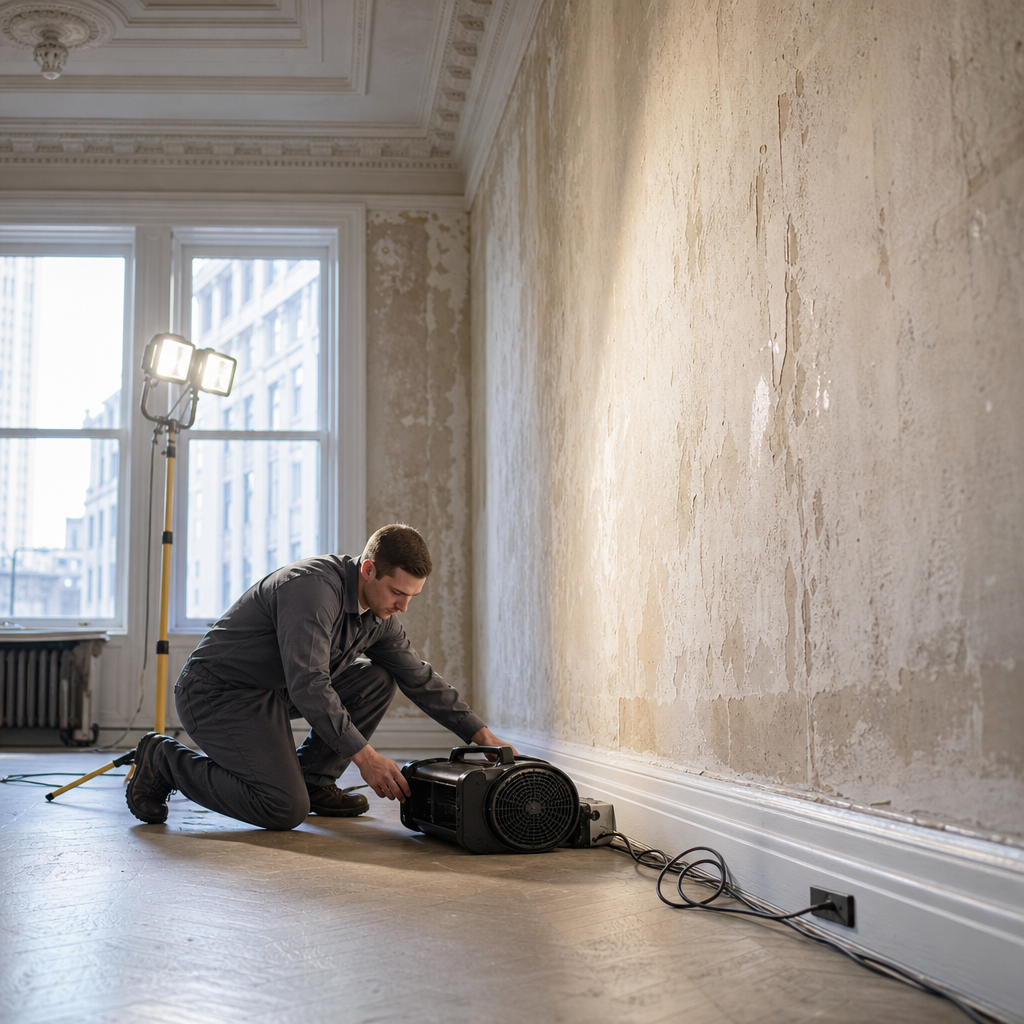
Midtown West properties feature a mix of modern drywall and traditional lath-and-plaster construction. Treating water intrusion requires techniques matched to the specific wall assembly.
Symptoms of Saturated Walls in Midtown West Buildings
Water leaking from upper-floor units often travels down internal pipe chases before showing up on lower ceilings and walls. In pre-war buildings, saturated plaster becomes heavy, leading to sagging ceilings, bubbling paint, and crumbly textures. Saturated plaster poses a collapse risk if not addressed quickly, while modern drywall wicks moisture upward, creating hidden pockets for microbial growth inside wall cavities.
Repair vs. Replace Guidelines for Pre-War and Modern Construction
Fast diagnostics keep property owners from tearing out more material than necessary. In modern construction, flood cuts are made 12 to 24 inches above the moisture line to dry wall cavities. Dense historic plaster, however, can often be saved using targeted cavity drying systems and non-invasive moisture meters. FEMA data highlights that early mitigation saves significant recovery dollars down the line by preserving original structural elements.[4]
Salvaging Hardwood Flooring, Subfloors, and Joists
Need flood cleanup cost midtown west nyc?
We’re available now - call for a fast, free estimate.
Hardwood flooring and structural joists require fast extraction to prevent permanent warping. Deploying commercial drying equipment within the first 24 hours often allows technicians to save original oak strip floors, parquet, or engineered planks without requiring full replacement.
Cupping, Crowning, and Structural Moisture Retention
Wood fibers expand as they absorb water. When moisture collects underneath the finish, board edges rise (cupping) or centers swell upward (crowning). In older brownstones, water can seep through floorboards into thick subfloors and structural joists. In newer high-rises, water sits on top of concrete slabs beneath underlayments. Daily moisture meter checks determine when materials return to dry standard before any refinishing work takes place.
Commercial Floor Mat Drying Systems vs. Tear-Out Costs
Using negative-pressure mat systems, a preferred method practiced by Wade’s Restoration, draws trapped moisture directly out through the grain of the wood. This approach saves historic flooring and avoids the heavy labor and disposal expenses associated with full floor replacement.
| Restoration Approach | Typical Cost Range | Logistical Impact |
|---|---|---|
| Commercial Floor Mat Drying | $1,200 – $2,500 | Extracts moisture through the wood surface; preserves existing flooring without major disposal needs. |
| Full Tear-Out & Replacement | $8,000 – $20,000+ | Requires complete subfloor replacement, new flooring materials, and extensive waste removal logistics. |
Navigating Co-Op Requirements, Building COIs, and Insurance Claims
Performing restoration work in Midtown West requires careful coordination with building rules and property insurance policies. Knowing how building requirements and coverage terms interact helps avoid unexpected out-of-pocket costs.
Commercial Property and Renters Insurance Coverage Realities
Most standard property policies cover sudden, accidental water discharge (such as a split supply hose or burst sprinkler head) but exclude overland storm surges unless a dedicated flood policy is in place. The Insurance Information Institute reports that water damage and freezing represent roughly a quarter of all commercial property claims. Detailed loss documentation is essential for straightforward claim processing.
Streamlining Insurance Approvals with Proper Documentation
To keep the claims process straightforward and support proper reimbursement, follow these steps:
- Keep detailed diagnostic records: Collect moisture readings, thermal camera images, and room-by-room damage photos before demolition starts.
- Coordinate building requirements early: Ensure your restoration provider submits necessary Certificates of Insurance naming the building management, co-op board, or landlord as additional insureds before setting up heavy drying equipment.
Frequently Asked Questions About Midtown West Flood Restoration
How fast can an emergency flood response team arrive?
Response times depend on specific contractor availability, traffic conditions, and property access, though emergency teams generally aim to arrive as promptly as possible across Midtown West to contain active leaks and set up extraction equipment.
How much does flood cleanup cost in Midtown West NYC?
Midtown West-specific municipal or authoritative pricing data was not found. However, New York City-wide estimates generally range from $4,726 to $5,522 for a 215-square-foot space ($24 to $28 per square foot). Total costs depend on whether the water is clean or contaminated, the extent of structural saturation, and the building layout.
Does property insurance cover water damage restoration in Midtown West?
Standard homeowner, commercial, and renters insurance policies typically cover sudden, internal water damage from broken plumbing or appliance failures. External flooding from street runoff generally requires a separate flood insurance policy.
What certifications should mitigation contractors hold?
Reputable restoration contractors should hold active certifications from the Institute of Inspection, Cleaning and Restoration Certification (IICRC), specifically in Water Damage Restoration (WRT) and Applied Structural Drying (ASD), along with proper state licensing and high-limit commercial liability insurance.
Need flood cleanup cost midtown west nyc?
We’re available now - call for a fast, free estimate.
Sources
- Severe Weather Events and Resiliency in New York State – osc.ny.gov (2024)
- Billion-Dollar Weather and Climate Disasters | New York Summary – ncei.noaa.gov (2024)
- THE CITY OF NEW YORK – nyc.gov (2013)
- Post-Disaster and Pre-Disaster Hazard Mitigation Assistance – congress.gov (2019)
Related reading: Cost of Wade’s Restoration Water Cleanup – Call Now-10% Off – Same-Day Service – Free Estimate
Frequently Asked Questions
How do Midtown West co-op and condo regulations affect emergency flood cleanup?
High-rises and co-ops in Midtown West enforce strict freight elevator reservations and high-limit Certificate of Insurance (COI) requirements before contractors can begin. Wade's Restoration coordinates directly with local building management to deliver approved COIs swiftly, ensuring rapid access and avoiding structural downtime.
How quickly can mold develop after water damage in a Midtown West apartment?
Moisture trapped behind plaster, drywall, or underlayment can trigger active mold colonization within 24 to 48 hours in enclosed Manhattan properties. Wade's Restoration offers 24/7 emergency response and free on-site visual inspections to halt moisture intrusion before secondary microbial contamination escalates restoration costs.
Can saturated hardwood flooring in historic Midtown West buildings be saved without replacement?
Yes, if emergency extraction occurs rapidly, specialized commercial negative-pressure drying mats can pull moisture directly through the wood grain to reverse cupping. Wade's Restoration uses these non-invasive mat systems to salvage original historic flooring and prevent disruptive tear-outs that often cost upwards of $8,000.
About the author
 |
Marcus Avery Marcus Avery is an IICRC-certified restoration specialist with over 12 years of experience in structural drying and water damage mitigation. Holding a B.S. in Construction Management from the Wentworth Institute of Technology, he frequently consults with property management firms in the tri-state area on emergency response planning. Marcus specializes in helping Midtown West property owners navigate complex water damage scenarios and detailed restoration cost analysis. |
Water damage, flood, or mold emergency?
We’re available now - call for a fast, free estimate.
Call Now - Free Estimate