
Quick Summary
Commercial water damage in high-rise and commercial properties demands immediate mitigation to prevent rapid vertical moisture migration, structural degradation, and costly business interruption. Wade's Restoration delivers 24/7 rapid emergency response across NYC, managing everything from high-capacity extraction and desiccant dehumidification to full structural reconstruction and carrier claim documentation. Facility managers will understand commercial restoration cost factors, critical containment procedures for mechanical and storm failures, and how to rapidly stabilize building envelopes to safeguard tenant operations.
Commercial Water Damage Restoration: Fast Emergency Recovery
When an upper-floor supply line shears or a storm surge floods a ground-floor lobby, Wade’s Restoration delivers fast commercial water damage restoration for commercial properties. Commercial drying costs are estimated to range from $3 to $7.50 per square foot, with moderate single-floor incidents typically estimated between $3,500 and $12,000. In high-density urban properties, every hour of standing water increases business interruption losses. Industry data from Zurich North America shows that water damage accounts for roughly 57% of Zurich North America commercial property claims, with average claim severity rising 8% in recent years.[2]
Property directors and facility managers cannot afford to wait on national call centers or unvetted subcontractors. We deploy certified technicians who manage the recovery from immediate vertical containment and high-capacity extraction to full structural rebuilds. Through our Claim Clarity Program, our team generates daily moisture logs and line-item Xactimate estimates directly for your adjuster. Call Wade’s Restoration 24/7 for emergency commercial response across commercial facilities.
Commercial Water Damage Restoration: Response Time, Process, and Core Priorities
Commercial water mitigation protects commercial assets by extracting bulk water, dehumidifying deep structural substrates, sanitizing affected spaces, and repairing damaged assemblies after pipe breaks, sprinkler discharges, or storm events. In high-rise environments, technicians isolate utility risers, seal multi-floor utility chases, and run commercial desiccant dehumidifiers to return tenant spaces to pre-loss condition.
Commercial water damage restoration requires a completely different approach than residential drying. In high-density office towers, hotels, and retail complexes, water moves rapidly along vertical pathways, threatening structural assemblies, electrical conduits, elevator hoistways, and tenant demising walls across multiple floors.
Why Multi-Story Structures Require Vertical Hydro-Dynamic Containment
High-rise water losses are vertical emergencies. When a pressurized line splits on the 30th floor, water follows gravity through electrical chases, duct penetrations, expansion joints, and elevator shafts. Analyses from Zurich North America and Verisk show that water damage remains the single largest driver of commercial property loss volume, with average claim severity climbing steadily since 2019. Containing these incidents requires vertical moisture mapping and negative-pressure zoning to stop liquid and vapor from traveling into lower tenant suites.[4]
The First 60 Minutes: Stabilizing the Envelope and Halting Active Migration
A fast stabilization protocol protects building infrastructure and limits revenue loss through four immediate actions:
- Shut down the mechanical supply valve and lock out affected electrical panels.
- Deploy high-volume extraction units across all impacted floor plates.
- Set up desiccant dehumidification systems to control vertical vapor drive in service shafts.
- Establish thermal baseline scans and psychrometric moisture logs for insurance claim validation.
If you are managing an active leak or flood emergency, contact Wade’s Restoration immediately to stabilize your building and safeguard business operations.
Emergency Water Damage Restoration for Commercial Properties
Commercial water damage restoration addresses mechanical failures and vertical water migration before concrete slabs become saturated. In dense urban buildings, stabilizing the property promptly prevents water from soaking drywall assemblies, running down utility chases, and triggering business interruption disputes with tenants.[5]
Rapid High-Rise and Commercial Facility Deployment
An Insurance Journal review of commercial losses showed that 32% of commercial property owners reported water intrusion or flood damage as one of their top claims in the past five years. Our crews arrive equipped to build containment zones around vertical chases and isolate moisture before it spreads across tenant boundaries.[1]
Stopping Upstream Water Ingress and Mechanical Failures
Mitigating severe mechanical events like riser blowouts, chiller line ruptures, and sheared fire sprinkler heads requires a systematic sequence:
- Mechanical Isolation: Shutting down upstream isolation valves and draining pressurized legs immediately.
- Chase and Shaft Containment: Sealing penetrations around HVAC risers, plumbing stacks, and electrical closets to block downward travel.
- Immediate Extraction: Running continuous-duty extraction tools to remove bulk water from finished floors and subfloors.
Commercial Flood Damage Restoration and Ground-Level Water Extraction
Ground-level and basement water damage restoration demands high-volume pumping to handle flash storm runoff and municipal sewer surcharges. Floodwaters carry heavy sediment and biological contaminants that soak into concrete subfloors, elevator pits, and mechanical vaults, requiring rapid sanitization to protect common areas and retail spaces.
Sub-Grade Ingress and Flash Flood Extraction
Subterranean infrastructure experiences intense hydrostatic pressure during severe downpours. When storm drains back up or retention basins overflow, restoration crews must deploy heavy-duty submersible pumps and extractors. Fast mobilization keeps standing water away from electrical switchgear, boiler rooms, and elevator mechanics.
Category 3 Water Neutralization and Antimicrobial Washing
Street runoff brings dangerous bio-loads into commercial corridors, requiring thorough decontamination:
- Gross Extraction: Pumping out Category 3 blackwater with high-flow extraction units.
- Antimicrobial Application: Treating masonry, concrete footings, and structural framing with EPA-registered disinfectants.
- Substrate Neutralization: Flushing deep-seated contaminants from porous structural materials.
Industry surveys indicate that nearly half of commercial property owners facing severe weather events rely on complete insurance recovery to rebuild. Prompt professional mitigation ensures all actions align directly with carrier requirements.[3]
Commercial Mold Remediation and Air Quality Containment
Commercial mold remediation isolates fungal growth following water intrusion before spores travel through shared ventilation networks. Certified technicians set up negative-pressure barriers and HEPA filtration to prevent cross-contamination between tenant floors during structural drying.
HEPA Negative Air Scrubbing in Shared HVAC Networks
Wade’s Restoration deploys certified remediation technicians to contain affected spaces. Technicians seal return plenums and mechanical chases with plastic barriers and install industrial HEPA air scrubbers. This process captures airborne spores and dust before moisture can circulate through centralized air handling systems.
Targeted Structural Decontamination and Clearance Testing
Preventing small moisture pockets from turning into large-scale microbial claims requires direct physical intervention:
- Build 6-mil poly containment barriers under continuous negative air pressure.
- HEPA-vacuum structural framing and apply EPA-registered antimicrobials to affected framing materials.
- Coordinate third-party Post-Remediation Verification (PRV) testing to confirm safe indoor air quality.
Commercial Sewage Cleanup and Biohazard Decontamination
Need commercial water damage restoration?
We’re available now - call for a fast, free estimate.
Commercial sewage cleanup involves the rapid containment, extraction, and hospital-grade sterilization of Category 3 blackwater. When plumbing stacks fail or municipal lines back up into commercial spaces, strict containment protects tenant health and prevents airborne contamination.
Main Line Backups and Grease Trap Overflows
Rising claim severity across commercial properties highlights the need for fast response during sewage events. When lower-level mechanical spaces or commercial kitchens experience drain backups, immediate containment keeps sewage from reaching subterranean utility vaults and foundation walls.
Sanitization, Odor Counteraction, and Waste Disposal
Biohazard restoration follows strict OSHA and industry guidelines:
- Containment and Disposal: Removing and disposing of saturated, porous building materials under regulated biohazard protocols.
- Surface Decontamination: Scrubbing non-porous subfloors and framing with broad-spectrum antimicrobials.
- Odor Counteraction: Running medical-grade air scrubbers and hydroxyl generators to eliminate airborne odors.
Commercial Fire and Smoke Damage Restoration Alongside Water Mitigation
When fire sprinklers discharge, large volumes of water mix with acidic soot. Mitigating a combined fire and water loss requires simultaneous water extraction, soot removal, and air scrubbing to prevent corrosion across electrical conduits and mechanical shafts.
Sprinkler Discharge and Suppressant Water Extraction
Discharging fire sprinklers release significant amounts of water. Fast extraction prevents this moisture from migrating into lower tenant spaces, elevator shafts, and retail areas.
Corrosive Soot Removal and Structural Deodorization
Acidic soot combined with high humidity rapidly corrodes metal framing, server racks, and light fixtures. Our teams handle these complex losses with a coordinated approach:
- Running commercial desiccant dehumidifiers to lower ambient humidity and stop corrosion.
- Applying alkaline cleaning solutions to neutralize acidic soot deposits on metal framing and building systems.
- Operating hydroxyl generators and HEPA scrubbers to clear combustion odors from shared air shafts.
Burst and Frozen Pipes in Commercial High-Rises
Sub-zero winter temperatures frequently cause perimeter fan coil units (FCUs) and unconditioned risers to freeze and rupture. A broken pipe on an upper floor sends high-pressure water racing down exterior wall assemblies, elevator banks, and electrical closets.
Perimeter Riser and Fan Coil Unit Freeze-Ups
According to the Insurance Institute for Business & Home Safety, burst pipes release substantial volumes of water, making them a leading cause of winter property losses. Wade’s Restoration uses thermal imaging cameras and acoustic leak detectors to locate hidden chase ruptures and dry building assemblies without unnecessary demolition.
Vertical Hydro-Dynamic Containment Down Multiple Floors
Managing multi-floor water flow requires isolating utility shafts on every level. Certified crews divert cascading water away from main distribution switchboards, set up drying equipment on each floor, and monitor moisture evaporation rates daily.
Basement Flooding and Sub-Grade Structural Drying
Sub-grade commercial spaces contain vital infrastructure, including electrical switchgear, elevator machinery, and boiler rooms. Pumping standing water out of subterranean vaults and drying thick concrete assemblies prevents long-term structural weakness and costly electrical failures.
Mechanical Room and Elevator Pit Water Removal
Industry records from BOMA show that basement water intrusion causes nearly a third of all building utility outages during major flood events. Technicians pump water from elevator pits and mechanical rooms quickly, cleaning and drying electrical components before corrosion destroys switches and controls.
Concrete Desiccant Dehumidification
Thick foundation walls and concrete floor slabs retain deep moisture that standard refrigerant dehumidifiers cannot pull out. We deploy industrial desiccant dehumidifiers that push extremely dry, low-dew-point air across masonry surfaces, extracting moisture from deep within the concrete.
Roof Leaks and Severe Storm Damage Mitigation
Severe coastal storms can tear low-slope roofing membranes, back up roof scuppers, and push water past parapet flashings. Fast overhead diversion and temporary roof seals keep water from soaking ceiling plenums and leaking down into upper-floor offices.
Commercial Flat Roof Membrane Failures and Parapet Breaches
Water intrusion through building envelope failures accounts for a substantial percentage of commercial property disputes. When ponding water overburdens roof drainage systems, water enters ceiling spaces and travels through lighting grids into tenant suites.
Emergency Board-Up, Tarping, and Interior Stabilization
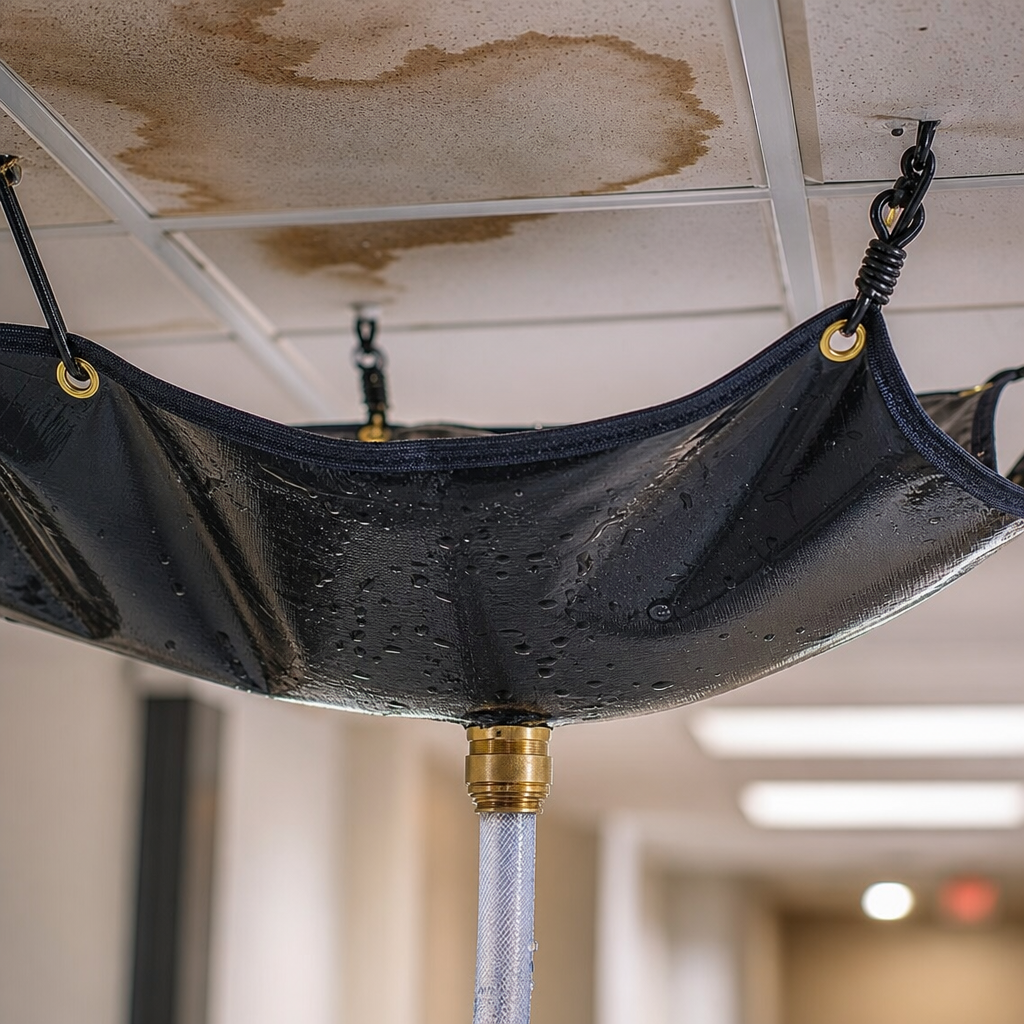
Restoration teams install exterior shrink-wrap, commercial membrane tarps, and interior drain diverters to redirect incoming water safely into containers or floor drains. This immediate protection keeps drop ceilings intact and shields tenant electronics from overhead water.
Commercial Sewage Backups: Emergency Sanitation Protocols
Sewage backups require instant isolation of the affected drain lines, physical containment of common hallways, and deep decontamination to remove hazardous bacteria. Stopping blackwater at the source keeps bio-aerosols from moving upward through plumbing stacks into occupied floors.
Municipal Main Surcharges and Drain Line Collapses
During heavy downpours, municipal combined sewer systems can surcharge, forcing wastewater backward through basement drains and plumbing fixtures. Installing high-pressure mechanical expansion plugs halts this backflow before sewage spreads into service corridors.
Preventing Pathogen Dispersion in Shared Tenant Properties
- Containment Barriers: Seal off affected restrooms and service corridors with plastic barriers under negative air pressure.
- Bulk Waste Removal: Extract blackwater immediately before it wicks into drywall framing and slab joints.
- Hospital-Grade Disinfection: Treat all affected structural surfaces with broad-spectrum antimicrobials.
Preventing Mold After Commercial Water Damage Events
Need commercial water damage restoration?
We’re available now - call for a fast, free estimate.
Stopping mold growth in commercial buildings requires drying structural materials back to normal moisture levels promptly. In high-rise offices, moisture often gets trapped behind commercial vinyl wallcoverings and above acoustic drop ceilings.
The 24 to 48 Hour Window for Microbial Prevention
The EPA warns that mold spores can start growing on damp drywall and ceiling tiles within 24 to 48 hours. Our technicians take fast action to prevent growth:
- Perforate or remove vinyl wallcoverings so trapped moisture can escape from drywall cavities.
- Take down soaked acoustic ceiling tiles to expose damp overhead slabs and deck assemblies.
- Set up high-capacity LGR and desiccant dehumidifiers to pull moisture out of the air and materials.
Deep Moisture Tracking with Infrared and Resistance Probes
Standard surface meters can miss water trapped inside insulated walls or under dense floor coverings. Technicians use infrared cameras and deep-wall resistance probes to track moisture trails down building chases, ensuring no hidden damp spots remain.
Fire and Smoke Damage Combined Loss Restoration
Restoring a property after a combined fire and water incident requires managing water extraction while simultaneously treating soot residues. Quick stabilization keeps acidic moisture from deteriorating drywall, framing studs, and high-voltage wiring.
Emergency Water Extraction After Fire Suppression
Water from fire suppression can submerge floors quickly. Deploying a single restoration team to manage both water pumping and soot cleanup avoids communication delays and prevents secondary structural rot.
Soot Scouring and Air Duct Thermal Deodorization
Smoke particles move easily through return air shafts and ceiling spaces. Mitigating these losses requires thermal fogging through duct networks and precision cleaning of machinery and tenant equipment to restore normal indoor air conditions.
Commercial Building Parts and Structural Components We Repair
Wade’s Restoration provides full-service structural drying and reconstruction. As a general contractor, we manage the transition from water extraction straight into complete architectural repairs.
Drywall, Drop Ceilings, and Plaster Assemblies
We dry wall cavities with targeted airflow, replace water-damaged acoustic ceiling grids, and hang fire-rated Type X drywall to match existing building specs.
Hardwood, VCT, Laminate, and Commercial Carpet Systems
Our technicians restore flooded commercial floors using specialized vacuum floor mat systems, deep hot-water extraction for commercial carpets, and glue-down VCT tile remediation.
Subfloors, Structural Joists, and Concrete Decking
Following IICRC S500 standards, we track moisture evaporation across steel studs, wood joists, and concrete slabs to ensure materials reach dry standards without warping or degrading.
HVAC Ductwork, Mechanical Chases, and Wall Insulation
Our crews pull out saturated fiberglass and mineral wool insulation, clean internal ductwork, and seal mechanical chases to protect tenant air quality.
What Does Commercial Water Damage Restoration Cost?
Commercial water damage restoration costs are estimated between $3 and $7.50 per square foot. Moderate single-floor or multi-room incidents are typically estimated between $3,500 and $12,000, depending on water category, building layout, and structural drying requirements.
Pricing Factors: Scope, Water Classification, and Structural Assembly
| Loss Scenario | Estimated Cost | Water Category | Standard Equipment Deployed |
|---|---|---|---|
| Moderate Single-Floor Loss | $3,500 – $12,000 (Estimated) | Category 1 or 2 | Desiccant Dryers, Injectidry Systems |
| Square-Foot Based Structural Mitigation | $3.00 – $7.50 / sq ft (Estimated) | Category 1, 2, or 3 | LGR/Desiccant Dehumidifiers, Air Movers |
| Sub-Grade Flood or Ingress | $3.00 – $7.50 / sq ft (Estimated) | Category 3 (Blackwater) | Submersibles, HEPA Air Scrubbers |
Navigating Insurance Claims and Carrier Documentation
Because water intrusion is one of the top commercial insurance claim categories, clear documentation makes all the difference during coverage reviews. Wade’s Restoration uses the Claim Clarity Program to provide adjusters with itemized Xactimate estimates, daily moisture logs, and thermal image reports, helping your claim proceed without disputes.
Commercial Water Damage Restoration Service Coverage
We provide commercial water damage restoration across high-density commercial corridors, business districts, and multi-story commercial facilities.
Commercial Corridor and Facility Coverage
Our teams operate throughout commercial business districts, corporate campuses, and industrial hubs. We maintain specialized mobile drying equipment ready for emergency dispatch 24/7.
Service Across Commercial Properties
Whether managing a multi-tenant commercial facility or a high-rise office building, Wade’s Restoration provides fast on-site extraction and structural drying. Contact us around the clock to start your property recovery.
Frequently Asked Questions About Commercial Water Damage Restoration
Managing water damage in commercial properties requires understanding containment practices, moisture tracking, and insurance claim processes. Here are straightforward answers to common questions about commercial restoration.
How Much Does Commercial Restoration Cost?
Commercial water mitigation is estimated to range from $3 to $7.50 per square foot, with moderate multi-room losses typically estimated between $3,500 and $12,000, depending on water contamination category, property layout, and required structural drying.
How Fast Can a Restoration Crew Arrive at My Property?
Wade’s Restoration provides 24/7 emergency dispatch to commercial properties, mobilizing crews promptly to assess the site and begin water extraction immediately.
What Licensing and Certifications Should a Commercial Contractor Possess?
A qualified commercial restoration contractor should maintain industry-standard credentials in structural drying and water remediation, appropriate general contracting qualifications, and comprehensive commercial liability coverage.
How Long Does It Take to Dry Out a Multi-Story Commercial Building?
The time required to dry structural slabs, metal framing, and utility chases depends on the class of water loss, affected materials, and environmental conditions. Dehumidification equipment runs continuously until moisture readings reach pre-loss baseline standards before repairs begin.
Need commercial water damage restoration?
We’re available now - call for a fast, free estimate.
Sources
- Water Damage Restoration Industry Statistics | 2026 Edition – worldmetrics.org (2026)
- Disaster Restoration Services Industry Statistics 2026 – worldmetrics.org (2030)
- In the Spotlight January 2026 Edition: Water Loss Severity Update – core.verisk.com (2026)
- Managing Water Damage Risk Involves Planning, Diligence – NAIOP – naiop.org (2021)
- State of Water Risk '26 – eddysolutions.com (2019)
Related reading: Flood Cleanup Cost Midtown West Nyc – Call Now-10% Off – Same-Day Service – Free Estimate
Related reading: Cost of Wade’s Restoration Water Cleanup – Call Now-10% Off – Same-Day Service – Free Estimate
Frequently Asked Questions
Can tenants continue operating in a high-rise building during commercial water restoration?
Yes, Wade's Restoration establishes negative-pressure containment barriers and utilizes targeted desiccant drying to isolate affected zones without disrupting tenant operations on neighboring floors. Our crews coordinate high-impact extraction and drying around business hours to minimize downtime and prevent operational disruptions.
How does Wade's Restoration assist facility managers with commercial insurance claim approvals?
Through our Claim Clarity Program, we provide adjusters with daily psychrometric moisture logs, infrared thermal scans, and itemized Xactimate estimates. This comprehensive documentation validates the scope of work according to carrier standards, eliminating coverage disputes and expediting claim resolution.
How is trapped moisture dried behind commercial vinyl wallcoverings without gutting walls?
Restoration specialists perforate or strategically remove impermeable vinyl wallcoverings to allow trapped moisture to evaporate from drywall assemblies within the critical 24- to 48-hour window. Wade's Restoration uses deep-wall resistance probes and targeted desiccant airflow to thoroughly dry internal wall cavities, preventing mold while avoiding unnecessary structural demolition.
About the author
 |
Marcus Avery Marcus Avery is an IICRC-certified restoration specialist with over 12 years of experience in structural drying and water damage mitigation. Holding a B.S. in Construction Management from the Wentworth Institute of Technology, he frequently consults with property management firms in the tri-state area on emergency response planning. Marcus specializes in helping Midtown West property owners navigate complex water damage scenarios and detailed restoration cost analysis. |
Water damage, flood, or mold emergency?
We’re available now - call for a fast, free estimate.
Call Now - Free Estimate