
Quick Summary
Accurately estimating commercial water damage cost requires evaluating hidden structural migration, contamination categories, and operational downtime rather than relying on generic per-square-foot metrics. Wade's Restoration demystifies these expenses by detailing key mitigation phases – such as rapid extraction, industrial dehumidification, and precise moisture logging – needed to control project scope. Facility leaders will understand how to navigate insurance claim requirements and can contact Wade's Restoration's 24/7 dispatch team for immediate mitigation and a free commercial inspection.
Commercial Water Damage Cost: Cut Losses and Downtime
Calculating commercial water damage cost requires looking far beyond basic clean-up rates. When a high-pressure line fails or a sprinkler head discharges in a commercial building, the price tag quickly compounds through structural migration, ruined inventory, tenant displacement, and lost operational hours. As unsourced operational guidance suggests, prompt response is critical to mitigating damage before water spreads across building systems.
Broad economic data underscores the sheer scale of water-related property risks. The U.S. Joint Economic Committee estimated annual direct commercial impacts from U.S. flooding at $31.6 billion to $40.0 billion in 2023. These overland flooding estimates are not interchangeable with costs for non-weather plumbing leaks or other indoor water-loss events. In addition, these aggregate economic figures are not directly comparable to individual carrier claim metrics due to differing scopes and methodologies, such as total economic impact versus mean loss, structural damage, and business interruption. Regarding major internal incidents, Allianz reported that severe commercial-property water-damage events can cause losses of millions of dollars, though this does not represent the outcome of every routine claim.[1]
Commercial Water Damage Cost: Emergency Pricing and Real-World Ranges
Overall restoration figures vary widely, and commonly cited commercial project ranges (such as $3,000 to $15,000 for localized incidents or $50,000 to over $100,000 for multi-floor losses) represent unverified estimates rather than research-backed typical prices. Furthermore, no dependable neutral commercial extraction average was established in the research brief. While broad, non-commercial references from independent compilations sometimes cite $2 to $6 per square foot, per-square-foot metrics do not reflect standard commercial project costs.
Every building presents unique structural variables. A localized leak on slab-on-grade retail space requires far less complex drying equipment than water trapped inside the concrete floor assemblies, soundproofing layers, and vertical utility chases of a multi-story office building.
Key Factors Behind Upfront Mitigation Expenses
Initial visual inspections rarely reveal the true scope of a commercial loss. The most significant expense drivers are often hidden behind finished surfaces and inside mechanical infrastructure. Rather than relying on simple per-square-foot cleanup metrics, facilities must account for the full scope of commercial losses, which can include physical repairs, lost business output, and indirect effects from building closures.
Evaluating commercial water loss figures requires understanding the different metrics used across the industry. Macroeconomic reports measure broad economic disruption, whereas carrier studies track mean policyholder payouts, direct physical repairs, or business interruption coverage. For instance, Chubb has reported a mean commercial water-damage loss of approximately $89,000, illustrating the impact of direct cleanup and secondary structural repairs. However, available figures should not be viewed as directly comparable given substantial variations in research methodology, claim frequency, structural damage measures, and business interruption scopes.[3]
Immediate Action Checklist for Facility Directors
- Isolate Utilities: Shut off the affected water riser immediately and isolate electrical feeds to wet zones to protect life safety and reduce equipment damage.
- Call Emergency Dispatch: Contact a dedicated commercial restoration team with immediate dispatch capabilities to assess structural moisture and establish containment.
- Map Hidden Moisture: Use thermal imaging cameras and calibrated moisture meters to track water travel through concrete decks, subfloors, and wall cavities before signing off on a scope of work.
What Does Commercial Water Damage Cost?
Need commercial water damage cost?
We’re available now - call for a fast, free estimate.
Total commercial water mitigation expenses are determined by contamination level, structural depth, required drying equipment, and off-hours labor rates. The following factors break down the primary line items that make up a commercial water damage estimate.
Commercial Water Damage Line-Item Pricing Ranges
In high-density commercial real estate, water rarely stays confined to one room. In an analysis of more than 470,000 claims, Allianz Global Corporate & Specialty reported that water damage accounted for 6% of global business insurance claims by frequency and 3% by total claim value. Over a ten-year span, North American insurers paid more than $2 billion in commercial water-damage claims.[2]
Direct project costs typically break down into several distinct phases, though specific price ranges remain unverified estimates:
- Emergency Water Extraction: Primary removal of standing water; neutral commercial averages are not established, and standard ranges remain unverified estimates.
- Structural Dehumidification and Air Movement: Daily commercial equipment rental fees for large-capacity LGR (low-grain refrigerant) dehumidifiers, desiccant units, and negative-pressure air movers.
- Targeted Demolition: Controlled removal of saturated drywall, acoustic ceiling tiles, insulation, and baseboards to access trapped moisture.
- Antimicrobial and Sanitization Treatments: Application of EPA-registered disinfectants across affected structural framing and subfloors.
Water Categories and Their Direct Price Impact
The contamination level of the water directly dictates the safety gear, disposal procedures, and labor intensity needed on-site. For context on extreme events, the New York City Department of City Planning documented that an unnamed industrial business estimated approximately $500,000 in storm damage during Hurricane Sandy.
| Factor | Category 1 (Clean Water) | Category 2 (Gray Water) | Category 3 (Black Water) |
|---|---|---|---|
| Contamination Level | None; broken supply lines or sink overflows | Moderate; appliance discharge, cooling tower leaks | Severe; sewage backups, storm surge, standing water |
| Extraction Cost Consideration | Unverified estimate; standard commercial averages not established | Unverified estimate; increased labor and filtration requirements | Unverified estimate; specialized hazardous handling required |
| Material Disposal | Minimal; most structural elements can be dried in place | Porous carpet padding, wet insulation removed | Aggressive tear-out of all porous surfaces, drywall, flooring |
| Sanitization Protocol | Standard airflow and moisture evaporation | Targeted antimicrobial washing on structural framing | Full containment barriers, HEPA filtration, biohazard washdown |
Why Water Migration Drives NYC Commercial Repair Expenses
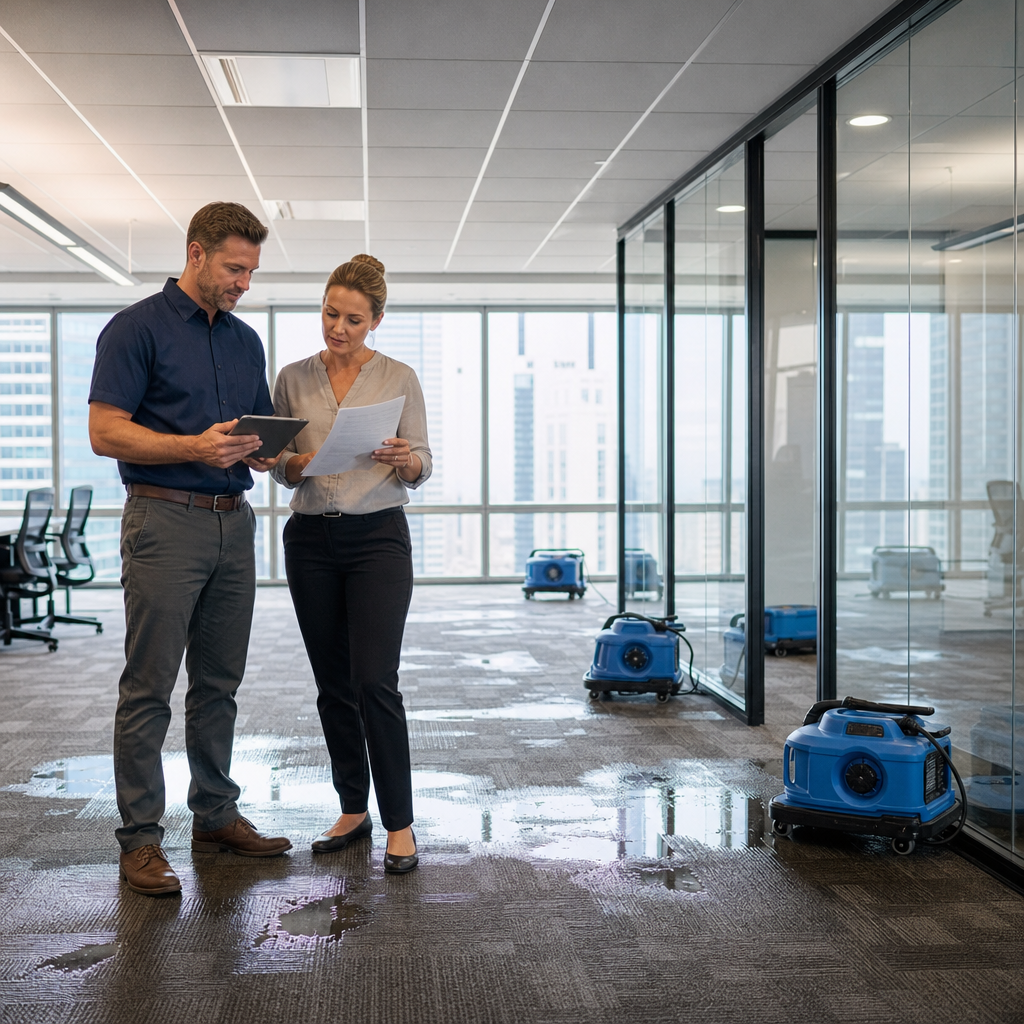
When a pressurized supply line or fire sprinkler pipe ruptures on an upper floor in a multi-story building, gravity immediately pulls thousands of gallons of water downward through mechanical shafts, electrical conduits, and floor penetrations. This multi-floor drainage escalates repair costs quickly across multiple tenant spaces.
Multi-Floor Drainage Through Elevator Shafts and Utility Risers
Elevator hoistways act as natural drainage channels during a major commercial water loss. Clearing flooded elevator pits, drying hoist cables, inspecting counterweights, and certifying electrical controls require specialized extraction crews and elevator technician coordination. These multi-trade requirements are never reflected in standard generic extraction estimates.
Drywall, Ceilings, and Subfloor Structural Remediation
Water migrating across concrete slabs saturates suspended acoustic ceilings, runs down metal-stud drywall tracks, and pools beneath raised access flooring. In older commercial properties, water can saturate dense masonry or historic plaster, requiring specialized drying setups. Industrial desiccant dehumidifiers must be placed strategically to pull moisture out of dense assemblies before mold colonization begins.
Does Commercial Property Insurance Cover Water Damage Restoration Costs?
Need commercial water damage cost?
We’re available now - call for a fast, free estimate.
Commercial property insurance coverage depends on the specific cause of loss and policy terms. Standard commercial property policies typically cover sudden and accidental internal water damage, such as a burst supply line, mechanical chiller failure, or accidental fire sprinkler discharge. However, flood is commonly excluded from standard commercial property policies and generally requires separate flood coverage.
Navigating Sudden Internal Failures vs. Flood Exclusions
Commercial coverage disputes frequently hinge on the exact point of origin. Allianz Global Corporate & Specialty reported that water damage accounted for 11% of all commercial construction-loss claims during the first three quarters of 2021, showing how vulnerable properties are during both construction and active operations. To protect coverage rights, property managers should ensure the physical cause of failure is documented immediately before damaged components are altered or discarded.[4]
Documentation and Moisture Logs
Insurance review processes evaluate empirical claim data before approving restoration line items. Commercial restoration teams like Wade’s Restoration typically maintain administrative records from day one, including:
- Daily psychrometric moisture logs tracking relative humidity, temperature, and grains per pound (GPP).
- Infrared thermal imaging maps establishing boundaries of moisture penetration.
- Detailed photo documentation of affected building assemblies and mitigation progress.
Commercial Restoration Management and Project Timelines
Splitting emergency drying, environmental testing, and general contracting across multiple disconnected vendors creates communication gaps, scheduling delays, and extended tenant downtime. A coordinated recovery approach brings extraction, structural drying, and reconstruction under a unified management plan to minimize business disruption.
From Emergency Extraction to Complete Reconstruction
A structured commercial recovery typically moves through emergency water extraction and stabilization, structural drying and decontamination, and eventual reconstruction to return the commercial property to its pre-loss state.
Frequently Asked Questions About Commercial Water Mitigation
How Much Does Commercial Water Damage Restoration Cost in Midtown West NYC?
Commercial water damage restoration costs in urban commercial districts depend heavily on project scope, contamination category, and multi-floor structural impact. Figures such as $4,000 to $25,000 for single-floor events or over $100,000 for complex multi-story losses represent unverified estimates rather than verified local pricing benchmarks. An accurate determination requires an on-site structural moisture inspection.
How Fast Can Mitigation Crews Arrive On-Site?
As general operational guidance, emergency response teams should be dispatched as quickly as possible following a loss. Rapid response helps halt continuous vertical migration through floor slabs and limits secondary damage.
What Certifications Do Commercial Restoration Technicians Hold?
Professional restoration teams should hold certifications from the Institute of Inspection, Cleaning and Restoration Certification (IICRC), specifically including Water Damage Restoration Technician (WRT) and Applied Structural Drying (ASD) credentials.
To inspect active commercial water damage or review an estimate for an existing loss, contact a local certified restoration specialist such as Wade’s Restoration to evaluate the property and stabilize the building immediately.
Need commercial water damage cost?
We’re available now - call for a fast, free estimate.
Sources
- Flooding Costs the U.S. Between $179.8 and $496.0 Billion Each Year – jec.senate.gov (2023)
- Business interruption claims | Allianz Commercial – commercial.allianz.com (2025)
- Managing Water Damage Risk Involves Planning, Diligence – NAIOP – naiop.org (2021)
- Managing Construction Risks: 10 Trends to Watch | Allianz Commercial – commercial.allianz.com (2021)
Related reading: Water Extraction Price Per Square Foot | Call Now-10% Off | Same-Day Service | Free Estimate
Frequently Asked Questions
Why do standard per-square-foot rates fail to accurately predict commercial water damage costs?
Per-square-foot metrics overlook structural complexities such as vertical water migration through utility risers, saturated concrete slabs, and specialized industrial drying needs. Wade's Restoration conducts comprehensive on-site thermal assessments to generate transparent line-item estimates based on actual structural depth, contamination levels, and equipment requirements.
What specific documentation do insurance adjusters need to approve commercial drying expenses?
Carriers require empirical proof of loss, including daily psychrometric logs tracking relative humidity and grains per pound, infrared thermal maps, and timestamped photo documentation. Wade's Restoration manages these detailed administrative records throughout the mitigation process to validate line-item drying costs and streamline claim payouts.
How can facility managers cut business interruption losses during a major water leak?
Partnering with a single emergency response team that coordinates water extraction, structural desiccant drying, and reconstruction prevents vendor hand-off delays and secondary mold damage. Facility leaders can contact Wade's Restoration for 24/7 emergency dispatch to quickly stabilize building assemblies and minimize tenant downtime.
About the author
 |
Marcus Avery Marcus Avery is an IICRC-certified restoration specialist with over 12 years of experience in structural drying and water damage mitigation. Holding a B.S. in Construction Management from the Wentworth Institute of Technology, he frequently consults with property management firms in the tri-state area on emergency response planning. Marcus specializes in helping Midtown West property owners navigate complex water damage scenarios and detailed restoration cost analysis. |
Water damage, flood, or mold emergency?
We’re available now - call for a fast, free estimate.
Call Now - Free Estimate