
Quick Summary
Handling combined fire and water damage repair in multi-story properties requires urgent, simultaneous mitigation to halt secondary structural decay, acidic soot binding, and toxic air contamination. As a premier single-source responder in Midtown West, Wade's Restoration eliminates contractor chaos by providing fast 45-minute emergency dispatch, coordinated water extraction and soot removal, seamless structural reconstruction, and direct insurance claim management. Readers will understand how to safely mitigate dual-peril losses and can call Wade's Restoration directly for 24/7 live emergency dispatch and a free visual inspection.
Fire and Water Damage Repair: Restoration and Recovery
When dealing with sudden fire and water damage repair, waiting hours for a response turns a manageable cleanup into a full structural rebuild. In a dense urban environment like Midtown West, water poured by fire hoses on an upper floor rapidly travels downward, soaking through ceiling assemblies, plaster walls, and utility risers. According to the U.S. Fire Administration, fire departments across the country respond to over 1.4 million fires each year, resulting in tens of billions of dollars in direct property loss. Independent insurance studies, including research from Aon, show that water damage can represent more than 40% of losses in certain property types. When fire and water strike at the same time, immediate intervention is the only way to save your property.[1]
Wade’s Restoration provides 24/7 emergency response throughout Midtown West, Hell’s Kitchen, and the Hudson Yards corridor. Our certified crews handle water extraction, structural drying, soot removal, and complete reconstruction under one roof. When you call, you speak directly with a local dispatcher who sends an experienced crew to your door with the right equipment to halt secondary damage on the spot. See also Water Damage Restoration Cost | Call Now-10% Off | Same-Day Service | Free Estimate.
Emergency Fire and Water Damage Repair: What to Expect Immediately
Emergency Fire and Water Damage Repair in brief: Once the property is declared safe to enter, technicians arrive on-site to secure utilities, extract standing water, set up air filtration, clean soot, and begin structural drying. Stabilizing humidity and capturing airborne particles as quickly as possible prevents structural rot, deep soot staining, and mold growth across adjacent living spaces.
Combined fire and water emergencies present two simultaneous threats. While standing water weakens floor joists and plaster, fine soot particles mix with moisture in the air to create an acidic film that tarnishes metals, etches glass, and penetrates porous structural materials. Stopping this reaction requires coordinated mitigation from the start.[4]
Immediate Mitigation Process
Every minute counts when water sits on subfloors while soot hangs in the air. Once the property is confirmed safe, technicians begin the mitigation process:
- Site Safety and Moisture Mapping: Crews inspect structural load points, test for hidden moisture paths behind walls using thermal cameras, and confirm electrical safety.
- Water Extraction and Structural Drying: Extractors pull standing water from flooring, subfloors, and low areas before drying equipment is placed to stop moisture migration.
- Soot Cleaning and Air Filtration: Air scrubbers and filtration equipment are deployed to capture airborne soot, volatile organic compounds (VOCs), and smoke odors before they settle into materials.
Hazard Containment and Stabilization
In multi-family brownstones and high-rise apartment buildings, containment prevents smoke and moisture from contaminating neighboring units. Our crews erect sealed polyethylene barriers under negative air pressure around the affected zones. This stops airborne soot from traveling through shared hallways and elevator banks while we stabilize the immediate loss area.
The Urban Vertical Stack Effect: Why Simultaneous Restoration Matters
Need fire and water damage repair?
We’re available now - call for a fast, free estimate.
As specialists at Wade’s Restoration emphasize, one of the biggest mistakes in multi-story property restoration is sequential treatment – attempting to dry the water completely before addressing soot and smoke. In tall buildings and pre-war structures, this approach triggers the Urban Vertical Stack Effect, which can cause permanent structural damage.
How Water and Soot Interact in Wall Cavities
When structural drying fans (air movers) are turned on without first capturing soot and balancing atmospheric pressure, rising warm air drafts sweep dry soot particles directly into damp, open wall cavities. The high ambient moisture from the water loss hydrates the soot, turning acidic carbon particles into a corrosive paste. This mixture coats hidden wiring, plumbing lines, and structural framing inside wall chases. Once dry, this residue hardens, leaving behind permanent chemical odors and accelerated corrosion that require tearing down entire walls later on.
Pre-War Brownstones vs. Modern High-Rise Air Shafts
Different building styles in Midtown Manhattan require tailored physical containment strategies:
| Structural Element | Midtown Pre-War Brownstones | Modern High-Rise Towers |
|---|---|---|
| Vertical Pathways | Horsehair plaster, open joist pockets, and vertical plumbing chases. | Pressurized HVAC shafts, electrical busways, and elevator shafts. |
| Vulnerability | Soot settles into porous lath and plaster; moisture wicks into antique subfloors. | Water cascades down service shafts, shorting out lower-level utility rooms. |
| Containment Approach | Zone isolation, targeted cavity drying, and rapid chemical soot neutralization. | HEPA-driven negative air barriers and floor-by-floor riser isolation. |
Restoring Core Building Components: Drywall, Hardwood, and HVAC Ducts
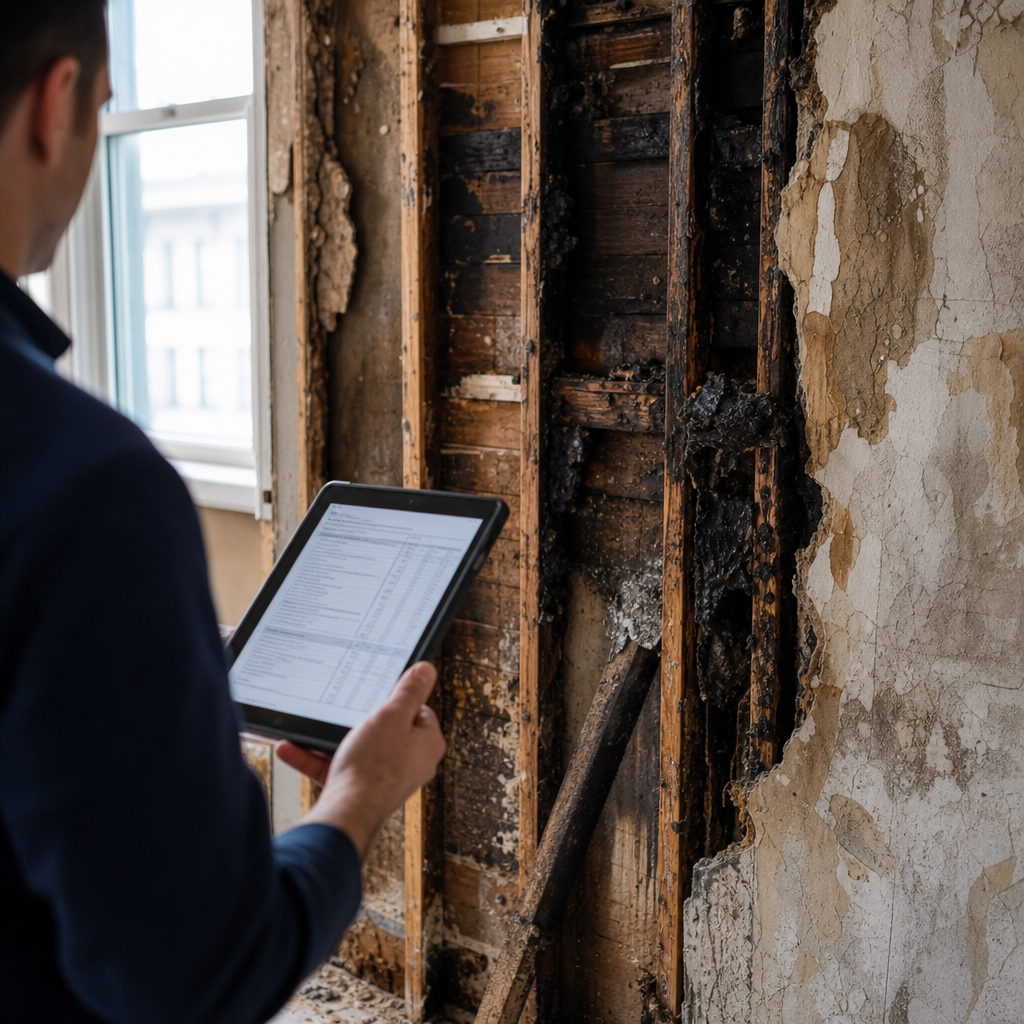
Restoring building materials after a dual-peril event requires knowing when an assembly can be saved and when it must be safely removed.
Drywall and Ceilings: Repair vs. Replace Criteria
According to Wade’s Restoration, standard drywall that has stayed submerged or saturated for more than 48 hours loses its structural binding and must be cut away. Our technicians establish a clean flood cut at least 12 to 24 inches above the highest moisture line, removing wet fiberglass insulation behind it. However, in historic properties with solid plaster and lath assemblies, we frequently preserve the original walls by using specialized structural cavity drying systems that circulate warm, dry air through precision-drilled access points.
Hardwood Flooring and Subfloor Joists
Hardwood floorboards absorb water quickly, causing cupping and crowning. If addressed early, high-powered desiccant dehumidifiers and floor drying mats can pull moisture directly through the wood grain, drawing the subfloor back down to equilibrium moisture content without requiring complete tear-out. If joists show soot staining from basement or lower-level fires, we use dry ice blasting or HEPA vacuuming to remove charred layers before applying an antimicrobial odor sealant.[3]
HVAC Systems and Shared Building Ductwork
Smoke drawn into central ductwork distributes fine particulates across every room connected to the system. We seal off all supply and return registers during the initial response. Once the main spaces are stable, we thoroughly clean the duct interiors, sanitize mechanical coils, and replace all filtration media with high-efficiency MERV-rated filters to ensure indoor air quality is safe.
Understanding Fire and Water Damage Restoration Expenses
Need fire and water damage repair?
We’re available now - call for a fast, free estimate.
Every restoration project is unique, with costs driven by the volume of standing water, the square footage exposed to smoke, and the accessibility of the building. A certified on-site visual inspection provides an exact, room-by-room scope of work based on current material conditions.
Key Factors That Drive Overall Restoration Expenses
- Water Contamination Level: Clean pipe breaks (Category 1) require straightforward extraction and drying. Firefighting runoff (Category 3) contains heavy ash, soot, and structural debris, demanding intensive sanitization and containment.
- Type of Smoke and Soot: Dry smoke from fast-burning wood is easier to clean than wet, sticky soot produced by synthetic materials, plastics, or kitchen grease fires.
- Structural Reconstruction Scope: Projects requiring framing replacement, finish carpentry, and custom plaster work involve dedicated trade labor beyond emergency mitigation.
Single-Source Restorer vs. Multiple Subcontractors
Hiring one contractor for water extraction, another for smoke cleanup, and a third for rebuilding creates scheduling gaps that allow moisture and mold to spread. Working with a single dedicated team keeps the project moving without downtime.
| Feature | Wade’s Restoration | National Franchise Hubs | Separate Independent Trades |
|---|---|---|---|
| Response Time | Direct dispatch, on-site fast | Often delayed by call routing | Depends on individual schedules |
| Mitigation Process | Simultaneous water extraction and soot removal | Often split between separate visits | Uncoordinated, sequential steps |
| Accountability | One point of contact from start to finish | Multiple rotating third-party crews | Multiple invoices and finger-pointing |
| Insurance Coordination | Direct line-item carrier billing | Standard regional estimates | Homeowner must compile receipts |
How to Navigate Insurance Claims for Combined Fire and Water Losses
Filing a property insurance claim for simultaneous fire and water damage can be complicated because insurance adjusters need to differentiate between covered fire damage and resulting sudden, accidental water damage from firefighting efforts or sprinkler systems. Accurate, immediate documentation is essential for prompt claim approval.[5]
Documenting Dual-Peril Structural Damage
From the moment our team arrives, we document all site conditions using digital moisture meters, thermal imaging scans, and high-resolution photography. We log atmospheric readings – including relative humidity, temperature, and grains per pound (GPP) – every day to prove that structural drying goals are being met according to industry standards.[2]
Working Directly with Adjusters
We work directly with your insurance adjuster to review the project scope. By providing itemized Xactimate estimates – the standard estimating software used across the property insurance sector – we eliminate guesswork and ensure all necessary demolition, drying, and rebuilding costs are clearly justified and covered under your policy terms.
Frequently Asked Questions About Fire and Water Damage Repair
How much does fire and water damage restoration cost?
Costs depend directly on the square footage, the height of water immersion, and the type of soot present. A localized room cleanup will require significantly fewer resources than a multi-floor structural loss involving saturated ceilings and ductwork. An on-site visual inspection allows technicians to map the exact boundary of the loss and provide a clear, itemized scope before work begins.
Does homeowners or commercial property insurance cover combined fire and water damage?
Standard property insurance policies generally cover damage resulting from covered fire events and sudden, accidental water damage caused by firefighting efforts or sprinkler discharge. Working with a certified restoration company that bills carriers directly helps ensure your claim is processed smoothly.
How quickly should water mitigation begin after extinguishing a fire?
Water mitigation should begin immediately once the scene is determined to be safe by the local fire department. Standing water begins warping subfloors and soaking into drywall within hours, and mold growth can start in as little as 24 to 48 hours in warm, damp conditions.
What steps are involved in the fire and water damage restoration process?
The process begins with immediate mitigation once the scene is safe, including water extraction, structural drying, soot cleaning, deodorizing, and final structural repair or rebuild.
Can smoke odor and water damage be permanently removed from a home?
Yes. Permanent odor removal requires physical removal of soot residues, thermal fogging or hydroxyl treatment to neutralize trapped odor molecules, and sealing exposed framing before closing up walls. Masking agents or surface sprays alone will not solve deep odor issues.
How long does the complete restoration and rebuilding process take?
Emergency water extraction and structural drying typically take three to five days. Complete reconstruction – including drywall replacement, painting, flooring installation, and trim work – can take anywhere from one to several weeks depending on the scale of structural damage and material lead times.
If your property has suffered sudden fire or water damage, contact Wade’s Restoration for 24/7 emergency dispatch and a direct on-site inspection.
Need fire and water damage repair?
We’re available now - call for a fast, free estimate.
Sources
- [PDF] Wildland Fire Summary and Statistics Annual Report (2025) – nifc.gov (2025)
- Detailed analysis of fires and response times to fires attended by fire … – gov.uk (2026)
- Statistics – USFA.FEMA.gov – usfa.fema.gov (2024)
- Fire and rescue incident statistics, year ending September 2025 – gov.uk (2025)
- State of Restoration 2026: Disaster & Insurance Data | Proof – proofco.ai (2026)
Related reading: Mold Remediation Cost – 10% Off & Free Estimate – Same-Day Service
Related reading: Emergency Restoration Services | Call Now-10% Off | On-Site in 60 Minutes | Free Estimate
Related reading: Flooded Basement Cleanup Cost | Call Now-10% Off | Same-Day Service | Free Estimate
Frequently Asked Questions
How do restoration crews prevent soot and moisture from spreading to neighboring apartments in multi-unit buildings?
In dense multi-unit properties, Wade's Restoration establishes sealed polyethylene containment barriers maintained under HEPA-driven negative air pressure. This isolates the work zone to prevent acidic soot particulates and elevated moisture from migrating through shared hallways, elevator shafts, or ventilation risers.
Can personal belongings and furniture be salvaged after exposure to both soot and firefighting water?
Many porous furnishings, electronics, and textiles can be saved if mitigation begins before acidic soot chemically binds with moisture. Wade's Restoration conducts on-site contents assessments, utilizing specialized desiccant drying, ultrasonic cleaning, and odor neutralization to restore salvageable items.
How does direct insurance billing work for combined fire and water damage claims?
Wade's Restoration collects digital moisture maps, thermal scans, and daily atmospheric logs to build carrier-approved Xactimate estimates. By submitting line-item documentation directly to your adjuster, our team justifies all mitigation and structural rebuilding costs to expedite claim approvals.
About the author
 |
Marcus Avery Marcus Avery is an IICRC-certified restoration specialist with over 12 years of experience in structural drying and water damage mitigation. Holding a B.S. in Construction Management from the Wentworth Institute of Technology, he frequently consults with property management firms in the tri-state area on emergency response planning. Marcus specializes in helping Midtown West property owners navigate complex water damage scenarios and detailed restoration cost analysis. |
Water damage, flood, or mold emergency?
We’re available now - call for a fast, free estimate.
Call Now - Free Estimate