
Quick Summary
When unexpected water, fire, or storm disasters threaten multi-unit and residential properties, rapid emergency restoration services are critical to halt structural degradation and vertical moisture spread. Wade's Restoration provides Midtown West property owners with rapid 45-minute on-site dispatch, handling everything from advanced thermal moisture mapping and structural drying to complete reconstruction and direct insurance claims coordination. Property owners can immediately request a free on-site visual inspection and 24/7 emergency mitigation from Wade's Restoration to protect building integrity and stop secondary mold growth within the crucial 24-to-48-hour window.
Emergency Restoration Services: 24/7 Property Recovery
When sudden water, fire, or storm damage hits your building, rapid intervention is essential to protect your property. Emergency restoration services provide 24/7 disaster mitigation to stabilize buildings quickly, beginning with an initial visual assessment and scope of work before mitigation begins.
According to the National Fire Protection Association (NFPA), home structure fires in 2024 caused 75% of civilian fire deaths and 62% of direct property damage from reported fires. Outside urban centers, wildfires also generate massive restoration demand, with the NFPA reporting that California wildfires alone accounted for an estimated $550 million in 2024 property losses. Whether managing a pipe rupture cascading down elevator shafts or dealing with soot and suppression water in a pre-war building, prompt mitigation is critical. Professional restoration technicians, such as those at Wade’s Restoration, manage recovery from structural drying to reconstruction and direct insurance documentation.[1] See also Water Damage Restoration Cost | Call Now-10% Off | Same-Day Service | Free Estimate.
24/7 Emergency Restoration Services: What to Expect and Response Times
Emergency restoration services provide rapid, round-the-clock disaster mitigation to secure, clean, dry, and rebuild properties damaged by water, fire, mold, or sewage. Crews arrive with commercial-grade extraction units, industrial desiccant dehumidifiers, HEPA air filtration systems, and infrared cameras to pinpoint hidden moisture, contain airborne contaminants, stop secondary mold growth, and restore the building to pre-loss condition.
Professional restoration contractors halt active damage on contact. In high-density urban environments, generic surface drying does not work. Water quickly escapes into utility chases, elevator pits, and shared floor assemblies, threatening multiple units if not captured immediately.
How Fast Can Restoration Crews Respond?
In an active disaster, speed determines whether building materials can be salvaged or must be torn out. Emergency restoration services are typically available 24/7, and response times vary by provider, location, and conditions. NYC properties present unique architectural challenges: water running down vertical riser stacks in high-rises or soaking historic horsehair plaster behind lath walls will cause rapid structural breakdown if left untreated for even a few hours.
What Steps Occur During Initial Dispatch?
To protect structural framing, limit mold risks, and keep repair expenses manageable, restoration technicians execute three targeted priorities upon arrival on-site:
- Multi-Level Thermal Mapping: Technicians trace hidden water migration behind drywall, plaster, and vertical service chases using calibrated moisture meters and thermal imaging cameras.
- Bulk Extraction and Negative Air Containment: High-volume extraction pumps pull standing water from flooring and mechanical rooms, while sealed negative-pressure barriers stop particulate, soot, and mold spores from migrating into neighboring units or shared corridors.
- Daily Psychrometric Monitoring: Crews record relative humidity, ambient temperature, and moisture content daily, building detailed line-item records and drying logs required by commercial insurance adjusters.
How Much Do Emergency Water and Fire Restoration Services Cost?
Need emergency restoration services?
We’re available now - call for a fast, free estimate.
Total restoration pricing varies based on the scope of damage, square footage, the contamination category of the water, structural access challenges, and how quickly mitigation begins. Large-scale multi-unit incidents, commercial property losses, severe sewage backups, or major fire recovery involve broader structural and containment requirements.[5]
Key Cost Drivers in Disaster Recovery
The contamination category directly determines safety measures and labor intensity. Category 1 clean water (such as a broken supply line) requires rapid extraction and targeted cavity drying. Category 3 black water (such as sewage backups or contaminated flood water) demands biosafety protocols, antimicrobial treatments, and mandatory removal of porous materials.
FEMA identifies flooding as the most common and expensive natural disaster in the United States. When standing water combines with fire soot or structural degradation, restoration complexity increases. Professional restoration providers like Wade’s Restoration streamline the process by generating industry-standard estimates, documenting moisture levels at every stage, and communicating directly with insurance carriers.
Drywall, Plaster, and Ceiling Restoration in Multi-Unit Buildings
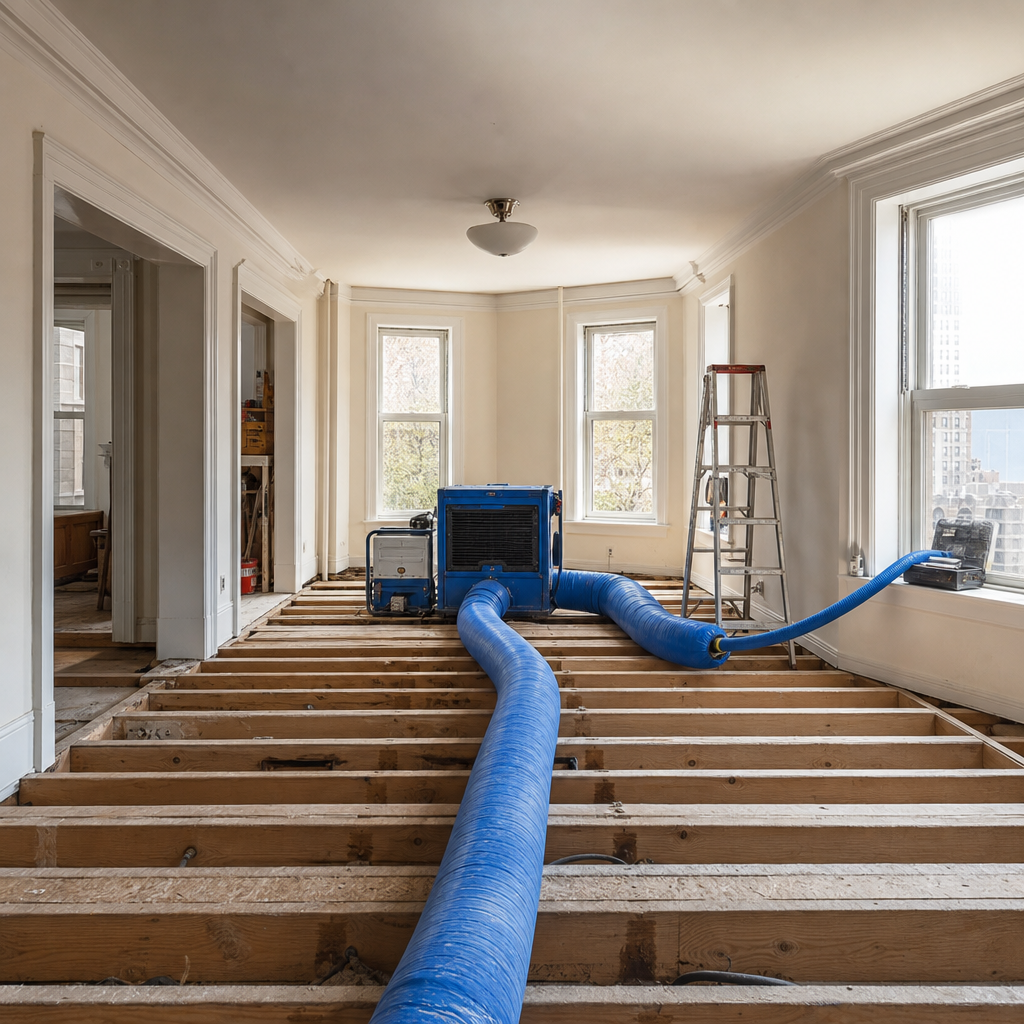
Drying waterlogged walls and ceilings in multi-family buildings requires vertical containment, moisture mapping, and techniques tailored to specific building materials. Gravity pulls water downward along utility risers, electrical conduits, and floor joists. Standard surface fans cannot dry these interior cavities, leading to ceiling collapses, electrical shorts, and hidden mold colonies behind unit walls.
Vertical Cavity Migration in High-Rises and Brownstones
In high-rises and pre-war brownstones, water moves quickly through shared party walls and structural chases. Historic horsehair plaster retains water far longer than modern drywall, requiring directed cavity-injection drying rather than passive open-air circulation. Suppression water from fire emergencies creates similar risks, soaking multiple floors below the source.[2]
Watch for these signs of vertical moisture migration:
- Sagging plaster or drywall ceilings, especially around light fixtures and sprinkler heads.
- Blistering paint, chalky mineral efflorescence, and soft spots on party walls.
- Musty odors originating from electrical outlets, baseboard gaps, or HVAC supply registers.
To prevent cross-contamination across shared hallways and ventilation shafts, crews like Wade’s Restoration establish negative air pressure zones with commercial HEPA air scrubbers before opening saturated wall cavities.
Repair vs. Replace Criteria for Saturated Walls
Choosing between structural drying and controlled material removal depends on water classification, structural integrity, and exposure duration:
| Evaluation Factor | Cavity Injection Drying (Preserve) | Controlled Flood Cut (Remove & Rebuild) |
|---|---|---|
| Water Classification | Category 1 clean water caught within 24 to 48 hours. | Category 2 or 3 water (gray water, sewage, or prolonged standing water). |
| Material Condition | Intact plaster keys, firm drywall core, no sagging. | Soft, swollen drywall, crumbling plaster, or wet fiberglass insulation. |
| Restoration Method | Heated, pressurized air injected via tiny access points behind baseboards. | Precision flood cut 12 to 24 inches above the water line, framing sanitization, and new drywall. |
Hardwood Floors, Subfloors, and Structural Framing Recovery
Need emergency restoration services?
We’re available now - call for a fast, free estimate.
Restoring soaked hardwood floors, historic parquet, and structural subflooring requires extracting moisture from underneath the boards. When water seeps beneath flooring into plywood or wood joists, high-pressure negative mat systems can pull moisture upward through the grain, saving wood if applied within the first 24 to 48 hours.
Identifying Cupping, Crowning, and Subfloor Delamination
Trapped subfloor moisture causes cupping, where the edges of the floorboards rise higher than the center. Crowning occurs when the board centers swell after surface moisture exposure or premature sanding. Technicians, such as those at Wade’s Restoration, use non-destructive impedance meters and deep probe sensors to assess subfloor moisture before permanent warping or delamination sets in.
| Floor Assembly Condition | Diagnostic Finding | Restoration Protocol |
|---|---|---|
| Salvageable Hardwood | Category 1 water; minor cupping; subfloor integrity intact. | Negative-pressure floor drying mats connected to commercial desiccant dehumidifiers. |
| Mandatory Removal | Category 3 contamination; delaminated subfloor layers; visible microbial growth. | Controlled floor removal, subfloor replacement, antimicrobial wash, and joist drying. |
How to Choose an Emergency Property Damage Restoration Company
When an emergency occurs, property owners benefit from choosing a full-service contractor that provides 24/7 emergency dispatch, trained technicians, and end-to-end reconstruction services. Working with a single provider from initial water extraction through final repairs prevents communication delays and ensures insurance claims proceed smoothly.
What to Look for in a Local Restoration Provider
- Industry Certifications: Technicians should hold recognized industry certifications in water damage restoration, applied structural drying, and fire and smoke restoration.
- Direct Insurance Coordination: Look for contractors who create detailed line-item estimates, submit drying logs, and work directly with property adjusters.
- Comprehensive Service Capabilities: Selecting a company capable of managing mitigation, remediation, and reconstruction keeps project timelines streamlined.
- Specialized Building Experience: Verify that the team understands vertical riser isolation, multi-unit building containment, and structural drying techniques.
Frequently Asked Questions About Emergency Restoration
What steps should I take while waiting for emergency restoration crews?
- Shut off the water supply: Turn off the main shutoff valve, branch line, or localized fixture valve immediately.
- Isolate electrical power: Turn off circuit breakers powering affected rooms if it is safe to access the electrical panel.
- Protect contents: Lift draperies off wet floors, move lightweight furniture to dry areas, and place aluminum foil or wood blocks under heavy furniture legs.
- Avoid hazards: Do not use household vacuum cleaners to extract water, and stay out of rooms where ceilings are visibly sagging from trapped water.
Does property insurance cover emergency restoration services?
Most standard homeowners, condo, and commercial property insurance policies cover sudden and accidental damage, such as burst pipes, appliance line ruptures, sprinkler discharges, and structural fires. Gradual leaks, maintenance neglect, or overland flood events generally require specific endorsements or separate flood policies. Restoration companies document all moisture readings and provide photographic evidence to support insurance claims.[3]
What services are included in 24/7 emergency property restoration?
Full-service emergency restoration includes immediate hazard assessment, water extraction, board-up and roof tarping, thermal moisture mapping, negative-pressure containment, structural dehumidification, soot and smoke removal, antimicrobial disinfection, content pack-out, and structural reconstruction.
How do restoration contractors prevent secondary property damage?
Secondary damage (such as mold blooms, drywall rot, warped subfloors, and etched glass from acidic soot) develops when water and smoke sit unmitigated. Contractors prevent this by initiating commercial extraction promptly, setting up HEPA air scrubbers to trap airborne spores, and operating desiccant dehumidifiers to drop relative indoor humidity below 50% within the critical 24-to-48-hour window.
If your property has experienced water, fire, or storm damage, contact an emergency restoration professional like Wade’s Restoration for 24/7 dispatch and an on-site visual assessment.[4]
Need emergency restoration services?
We’re available now - call for a fast, free estimate.
Sources
- Statistics – USFA.FEMA.gov – usfa.fema.gov (2024)
- The Cost of Flooding – floodsmart.gov (2024)
- Fire in the United States, 13th Edition – usfa.fema.gov
- (TLP:CLEAR) Research Report – 2025 Year-in-Review Billion Dollar … – waterisac.org (2025)
- Research Summary: U.S. Fire Loss in 2024 – nfpa.org (2024)
Related reading: Mold Remediation Cost – 10% Off & Free Estimate – Same-Day Service
Related reading: Flooded Basement Cleanup Cost | Call Now-10% Off | Same-Day Service | Free Estimate
Related reading: Water Extraction Cost | Call Now-10% Off | Same-Day Service | Free Estimate
Frequently Asked Questions
How fast can emergency restoration services respond to a property disaster in Midtown West?
Wade's Restoration provides 24/7 emergency dispatch with rapid 45-minute on-site arrival throughout Midtown West. Immediate deployment allows certified technicians to set up negative air containment, conduct multi-level thermal mapping, and halt vertical moisture migration before secondary damage sets in.
How do emergency restoration contractors assist with property insurance claims?
Full-service contractors like Wade's Restoration handle direct insurance coordination by supplying adjusters with line-item estimates, daily psychrometric logs, and photographic evidence. This comprehensive documentation streamlines claims processing for sudden and accidental water, smoke, or storm incidents.
Can historic plaster walls and hardwood subfloors be saved after water damage?
Yes, deploying high-pressure negative mat systems and cavity-injection drying within the initial 24-to-48-hour window can successfully salvage historic plaster and wood assemblies without full demolition. Property owners can schedule a free on-site visual inspection with Wade's Restoration to evaluate moisture penetration and determine if non-destructive structural drying is viable.
About the author
 |
Marcus Avery Marcus Avery is an IICRC-certified restoration specialist with over 12 years of experience in structural drying and water damage mitigation. Holding a B.S. in Construction Management from the Wentworth Institute of Technology, he frequently consults with property management firms in the tri-state area on emergency response planning. Marcus specializes in helping Midtown West property owners navigate complex water damage scenarios and detailed restoration cost analysis. |
Water damage, flood, or mold emergency?
We’re available now - call for a fast, free estimate.
Call Now - Free Estimate