
Quick Summary
Residential water extraction cost depends on standing water volume, contamination levels, and structural moisture migration, making rapid physical extraction essential to prevent extensive structural degradation and mold. Wade's Restoration utilizes standardized line-item pricing and advanced vacuum equipment to salvage building materials, minimize out-of-pocket expenses, and support property insurance claims with thorough documentation. After reviewing this guide, property owners can accurately assess emergency mitigation estimates and contact Wade's Restoration for a free visual inspection or 24/7 emergency dispatch with 45-minute response times.
Residential Water Extraction Costs: Mitigation Rates and Pricing Factors
While the term “water extraction cost” can refer to industrial water withdrawal fees, resource pricing across economic sectors, and regional utility charges as documented by Statistics Canada and academic studies, this guide specifically addresses residential water mitigation and emergency standing water removal. Physical water extraction is the critical first step to prevent ongoing structural degradation, material deterioration, and mold growth in homes.[2]
When water intrudes into a multi-story home or single-family residence, it can travel through floor assemblies, wall cavities, and utility channels. Understanding how water mitigation contractors like Wade’s Restoration evaluate extraction helps property owners assess emergency estimates, navigate the claims process, and address damage quickly.[5] See also Water Damage Restoration Cost | Call Now-10% Off | Same-Day Service | Free Estimate.
Emergency Water Extraction: Pricing Factors and Service Scope
Water removal pricing depends on the volume of standing water, the source and contamination level of the water, and the specific materials affected. Removing clean water from accessible surfaces involves different equipment and labor requirements than extracting contaminated water from carpeted areas or layered structural materials.
Water Extraction Considerations by Contamination Level
Mitigation industry guidelines generally assess projects based on the contamination level of the water source, which influences safety measures, equipment needs, and overall cost:
- Clean Water: Originates from broken supply lines, overflowing sinks, or appliance malfunctions. Materials can often be dried in place if mitigation begins promptly.
- Gray Water: Involves discharge from washing machines, dishwashers, or sump pump overflows containing biological or chemical contaminants, requiring cleaning and localized material removal.
- Black Water: Involves sewage backups, floodwaters, or standing water that has deteriorated over time. This requires specialized containment, personal protective gear, and the removal of unsalvageable porous materials.
Key Pricing Factors
Total emergency water removal costs reflect mechanical and environmental requirements:[3]
- Water Depth and Volume: Significant water depth may require high-capacity pumps before vacuum extraction equipment can be deployed.
- Contamination Level: Higher contamination levels require specialized sanitization protocols, protective containment, and disposal measures.
- Response Time: Prompt extraction helps limit material swelling, delamination, and microbial growth.
Water Extraction vs. Complete Water Damage Restoration
Water extraction is distinct from full water damage restoration. Extraction represents the narrower initial process of physically removing standing and pooled water, whereas comprehensive restoration includes drying, sanitizing, repairing, and rebuilding damaged areas. Overall costs vary widely based on contamination level, affected materials, and project scope.[1]
| Service Scope | Surface Extraction | Cavity & Subfloor Extraction | Full Structural Restoration |
|---|---|---|---|
| Target Materials | Flooring surfaces, standing water pools | Subfloors, structural framing, wall cavities | Framing, drywall, trim, cabinetry, finishes |
| Scope and Complexity | Narrow: focuses on standing liquid removal | Moderate: targets trapped moisture in building assemblies | Comprehensive: includes structural repairs and rebuild |
| Primary Equipment | Extraction vacuums, portable and truck-mounted units | Specialized drying mats, cavity drying systems | Dehumidifiers, air movers, containment systems |
| Primary Objective | Removes bulk liquid from surfaces | Draws trapped moisture from concealed assemblies | Restores and rebuilds damaged structural components |
Understanding Extraction and Drying
Physical extraction mechanically removes liquid water much more rapidly than relying on evaporation and dehumidification alone. Removing bulk water before setting up drying equipment helps reduce total drying time, equipment run-time, and secondary moisture damage inside enclosed building cavities.
Multi-Story and Structural Water Migration
Need water extraction cost?
We’re available now - call for a fast, free estimate.
In multi-level properties, water naturally travels downward through ceiling assemblies, utility chases, and subflooring, expanding the affected surface area across multiple levels.
Inter-Floor Cavity Moisture
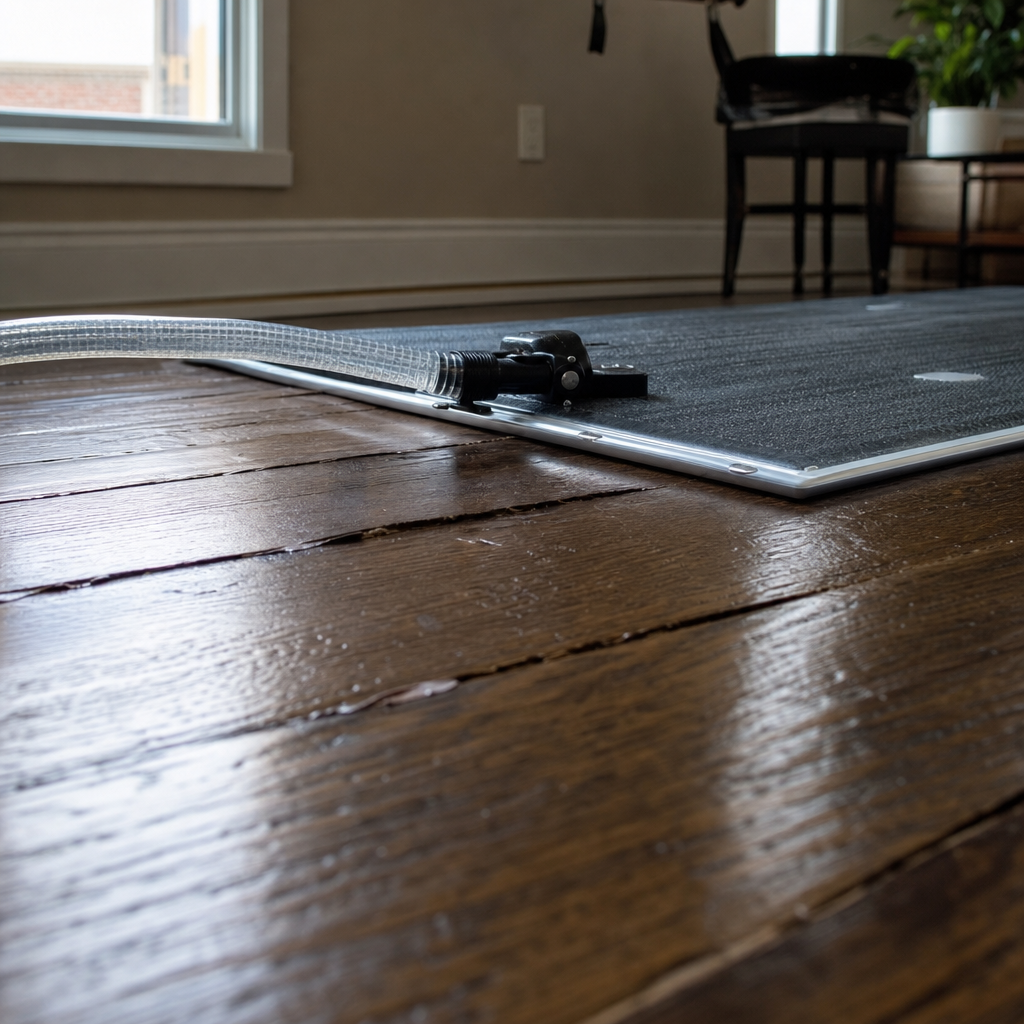
When an upper-level leak occurs, water can accumulate within floor and ceiling cavities. If hidden moisture remains trapped between floors, it can damage structural framing, ruin finishes, and promote mold growth. Mitigation professionals, such as the technicians at Wade’s Restoration, often employ specialized drying systems, such as targeted air injection or suction panels, to dry these spaces with minimal structural disruption.
Structural Considerations by Building Type
Building construction and architectural layout influence extraction procedures and complexity:
| Building Type | Primary Migration Pathway | Mitigation Approach |
|---|---|---|
| Older and Historic Residences | Timber framing, tongue-and-groove flooring, lath and plaster | Targeted cavity drying and controlled dehumidification to preserve original building elements where feasible. |
| Modern Multi-Unit Buildings | Drywall chases, utility shafts, concrete and metal decks | Containment measures, multi-level extraction, and isolation of affected utility conduits. |
Evaluating Materials: Salvage, Drying, and Replacement
A primary objective during residential water mitigation, as emphasized by Wade’s Restoration, is evaluating whether building materials can be dried and salvaged or must be removed.
Hardwood and Subfloor Assemblies
Hardwood flooring and subflooring absorb moisture at different rates. Prompt extraction using specialized vacuum mat systems can sometimes pull moisture from the flooring and subfloor assembly, reducing the extent of warping, cupping, or full replacement.
Drywall, Insulation, and Ceilings
Porous materials vary in their ability to be dried depending on water quality and exposure time:
- Drywall: When moisture wicks into drywall, technicians may perform flood cuts above the moisture line to facilitate airflow into framing cavities.
- Insulation: Wet fibrous insulation generally loses its insulating properties and is typically removed when saturated.
- Plaster: Traditional plaster assemblies may be salvageable if structurally stable and dried under controlled conditions.
Mitigation Estimates, Pricing Methods, and Insurance
Restoration companies typically prepare itemized estimates based on standard industry estimating software and operational scopes, accounting for regional labor rates, equipment use, and materials.
Common Line Items in Mitigation Invoices
Itemized mitigation estimates generally include specific operational activities:
- Service Dispatch: Initial emergency response and site assessment.
- Water Extraction: Physical pumping and vacuum extraction calculated by affected area or hours of operation.
- Antimicrobial Treatment: Application of sanitizing solutions where appropriate to address microbial growth.
- Equipment Deployment: Daily monitoring and usage fees for commercial dehumidifiers and air movers.
- Moisture Inspection: Moisture mapping using meters and thermal imaging to verify drying progress.
Insurance Documentation
Insurance coverage for water mitigation typically depends on the underlying cause of the water intrusion and the specific terms of the policy. Sudden and accidental water discharges are commonly covered under standard property policies, whereas gradual leaks or outdoor flooding typically involve specific policy limits, exclusions, or separate flood insurance. Restoration technicians, including specialists from Wade’s Restoration, frequently maintain moisture logs, psychrometric readings, and photo documentation to support claims processing.
Frequently Asked Questions About Water Extraction Costs
What determines the cost of residential water extraction?
Residential extraction costs depend on the volume of standing water, the contamination category of the water source, accessibility of the space, the types of materials affected, and the extent of specialized drying equipment required.[4]
Does property insurance cover water extraction?
Property insurance coverage generally depends on whether the water intrusion is classified as sudden and accidental under the policy terms. Gradual leaks, maintenance neglect, and surface water flooding are often subject to specific exclusions or separate endorsements.
What is the difference between water extraction and water damage restoration?
Water extraction refers specifically to the physical removal of standing liquid from a structure. Water damage restoration is a broader process that encompasses comprehensive drying, sanitization, structural repairs, and rebuilding affected building components.
How does water contamination level impact extraction procedures?
Clean water incidents typically require straightforward vacuum extraction and drying. Gray and black water incidents require additional safety protocols, sanitizing treatments, and disposal of porous materials that cannot be safely restored.
How do mitigation contractors formulate pricing?
Contractors like Wade’s Restoration use industry-standard estimating platforms to generate line-item pricing based on the square footage treated, equipment run-time, labor hours, disposal fees, and specific monitoring tasks performed.
Need water extraction cost?
We’re available now - call for a fast, free estimate.
Sources
- https://openknowledge.worldbank.org/server/api/cor… – openknowledge.worldbank.org (2050)
- [PDF] Water Pricing, Costs and Markets – watercommission.org (2011)
- Total water costs in mineral extraction and thermal-electric … – www150.statcan.gc.ca (2024)
- Water acquisition costs in mineral extraction and thermal … – www150.statcan.gc.ca (2024)
- A quantification and analysis of historical sectoral … – tandf.figshare.com (2018)
Related reading: Mold Remediation Cost – 10% Off & Free Estimate – Same-Day Service
Related reading: Flooded Basement Cleanup Cost | Call Now-10% Off | Same-Day Service | Free Estimate
Frequently Asked Questions
How quickly does water extraction need to begin to avoid costly structural tear-outs?
Physical extraction should ideally begin within 24 to 48 hours to prevent mold colonization and permanent structural swelling in subflooring and drywall. Wade's Restoration provides 24/7 emergency dispatch with 45-minute response times to extract standing water quickly, preserving salvageable materials and keeping overall restoration costs down.
How does Wade's Restoration help property owners navigate insurance claims for water extraction?
Technicians generate standardized, itemized estimates and maintain thorough moisture logs, thermal images, and psychrometric data throughout the mitigation process. This clear documentation substantiates your claim with insurance adjusters for covered sudden and accidental water events, significantly reducing unexpected out-of-pocket expenses.
Can emergency water extraction save saturated hardwood floors from total replacement?
Yes, deploying specialized vacuum drying mats and targeted subfloor extraction can draw out trapped moisture before planks warp, cup, or delaminate. Wade's Restoration performs a free visual inspection and moisture mapping evaluation to determine if advanced extraction can successfully salvage your wood flooring instead of requiring a complete tear-out.
About the author
 |
Marcus Avery Marcus Avery is an IICRC-certified restoration specialist with over 12 years of experience in structural drying and water damage mitigation. Holding a B.S. in Construction Management from the Wentworth Institute of Technology, he frequently consults with property management firms in the tri-state area on emergency response planning. Marcus specializes in helping Midtown West property owners navigate complex water damage scenarios and detailed restoration cost analysis. |
Water damage, flood, or mold emergency?
We’re available now - call for a fast, free estimate.
Call Now - Free Estimate