
Quick Summary
Standard water damage restoration cost per square foot typically ranges from $3.00 to $7.50 for emergency mitigation and structural drying, while complete reconstruction adds an additional $20 to $37 per square foot. Wade's Restoration delivers transparent, line-item pricing and rapid extraction to stabilize Category 1 clean water, Category 2 gray water, and Category 3 black water before secondary mold and structural rot develop. Readers will understand the primary cost drivers across multi-story and basement water losses and can contact Wade's Restoration 24/7 for immediate dispatch, detailed moisture mapping, and insurance claim documentation.
Water Damage Restoration Cost Per Square Foot: Pricing Guide
The average water damage restoration cost per square foot falls between $3.00 and $7.50 for standard drying and mitigation. Clean water supply line breaks sit on the lower end at around $3.50 per square foot, gray water from washing machines or dishwashers averages $5.25, and biohazardous black water runs $7.50 or more. If water sits unaddressed, it quickly migrates into subflooring and wall cavities, turning a straightforward dry-out into an expensive reconstruction job.[1]
In dense urban properties, simple floor-plan math rarely tells the whole story. Gravity pulls water straight down plumbing chases, behind plaster, and into lower-level units, meaning vertical containment and logistics dictate the true scope of work. Professional restoration, as practiced by specialists like Wade’s Restoration, covers the recovery process from emergency physical extraction to structural repairs, using on-site visual inspections, detailed moisture mapping, and line-item documentation for property claims.
Water Damage Restoration Cost Per Square Foot: Pricing Breakdown
Quick Summary: Mitigation and structural drying run from $3.00 to $7.50 per square foot. Category 1 clean water averages $3.50 per sq ft ($3.00 to $4.00), Category 2 gray water averages $5.25 per sq ft ($4.50 to $5.50), and Category 3 black water averages $7.50 per sq ft ($7.00 to $7.50+). Structural reconstruction, including framing, drywall, and finish flooring, runs separately at roughly $20 to $37 per square foot.
Mitigation pricing covers the urgent work needed to stabilize the property: extracting standing liquid, tearing out unsalvageable porous items, setting up negative air containment, and running commercial dehumidifiers. Total project costs depend heavily on the sanitation category of the water and how deep the moisture traveled before extraction began.
Average Price per Square Foot by Water Category
Water source contamination dictates technician safety protocols, disposal rules, and equipment needs, which directly affects the overall water extraction and mitigation price per square foot:
| Water Category | Typical Contamination Source | Mitigation Cost / Sq. Ft. |
|---|---|---|
| Category 1 (Clean) | Broken supply lines, sink overflows, rainwater through clean roof leaks | $3.00 – $4.00 (Average: $3.50) |
| Category 2 (Gray) | Washing machine discharge, dishwasher overflows, sump pump failures | $4.50 – $5.50 (Average: $5.25) |
| Category 3 (Black) | Sewage backups, toilet overflows with feces, street floodwaters | $7.00 – $7.50+ (Average: $7.50) |
Mitigation vs. Full Structural Reconstruction Costs
Drying out a space is only stage one. When sheetrock saturates, hardwood cups, or subflooring swells, structural repairs become necessary. Rebuilding damaged areas runs separately and considerably higher than extraction, typically between $20 and $37 per square foot depending on finish grades. Managing total commercial water damage cost comes down to moving fast: catching the water in the first few hours preserves studs, joists, and architectural finishes before they require replacement.
Emergency Water Damage Restoration
Emergency restoration focuses on immediate physical extraction and stabilizing ambient humidity. A standard water extraction and mitigation cost per square foot stays in the $3.00 to $7.50 range only if standing water is removed before it seeps into structural assemblies. Every hour of delay lets water wick upward into drywall and seep downward through flooring layers, compounding the final repair bill.
Rapid Extraction to Halt Moisture Migration
Pumping out standing water halts the capillary action that pulls moisture up through baseboards and wall studs. Because rebuilding runs roughly $20 to $37 per square foot, extracting standing liquid immediately protects the surrounding structure and keeps costs confined to basic mitigation rates.
Multi-Unit and High-Rise Building Protocols
In high-rise residential towers and multi-unit commercial spaces, water follows gravity down electrical conduits, elevator shafts, and shared mechanical risers. Containing the loss requires a coordinated approach:
- Immediate Vertical Containment: Technicians isolate wet utility chases on the source floor and immediately check the units directly beneath.
- Heavy-Duty Industrial Drying: Crews position desiccant dehumidifiers and high-cfm air movers to pull dampness from shared assemblies before secondary damage spreads to neighboring tenants.
Flood Damage Restoration
Overland storm surges, street runoff, and river overflows are classified as Category 3 black water. These events bring silt, bacteria, petrochemicals, and heavy biological contaminants into ground-floor spaces, making simple surface extraction inadequate. Black water cleanup averages $7.50 per square foot ($7.00 to $7.50+) because all affected porous items must be stripped and discarded as hazardous waste.
Storm Surge and Flash Flood Recovery
Garden-level apartments and street-level retail shops face heavy sediment deposits during severe weather. Restoring these spaces involves three clear steps:
- Bulk extraction of contaminated sludge and water to stabilize the perimeter.
- Controlled demolition, cutting out saturated drywall and insulation at least 12 to 24 inches above the visible flood line.
- Application of EPA-registered antimicrobial washes across bare masonry, slab surfaces, and wall framing.
Sanitization and Moisture Monitoring
Preventing microbial growth after a flood requires verified documentation. Restoration teams, including technicians from Wade’s Restoration, track daily relative humidity, ambient temperature, and moisture levels in structural wood using calibrated penetrating meters. These drying logs provide insurance adjusters with the technical proof needed to process and approve claims.
Mold Remediation
Professional mold remediation costs vary depending on the square footage of the affected zone and structural accessibility. Because mold spores activate within 24 to 48 hours of water exposure, any delay in drying can trigger microbial containment requirements alongside standard structural dry-out work.
Containment and Air Filtration
When fungal colonies form inside shared wall cavities or HVAC chases, remediation crews erect plastic containment zones held under negative air pressure. Industrial HEPA air scrubbers run continuously to trap circulating spores, preventing airborne cross-contamination into living areas or neighboring units.
Safe Demolition and Antimicrobial Treatment
Remediation follows strict decontamination standards:
- Establish sealed containment chambers with zippered access points.
- Bag and remove contaminated plaster, insulation, and drywall under negative pressure.
- HEPA-vacuum exposed framing, treat wood surfaces with antimicrobial wash, and seal structural elements where needed.
Sewage Cleanup
Need water damage restoration cost per square foot?
We’re available now - call for a fast, free estimate.
Raw sewage backups pose severe biological hazards. Category 3 wastewater introduces viruses, parasites, and bacteria into living and working spaces. In multi-story buildings, back-pitched drain stacks or main municipal blockages can send sewage bubbling out of toilets and floor drains across several floors simultaneously, demanding prompt containment and heavy disinfection.
Category 3 Biohazard Mitigation
Industry standards mandate that porous materials saturated by raw sewage cannot be saved. Technicians follow an aggressive recovery protocol:
- Extraction of standing wastewater using sealed, direct-vacuum recovery tanks.
- Immediate removal and bagging of contaminated carpeting, baseboards, underlayment, and drywall.
- Containment of adjacent vertical chases to stop off-gassing and bacterial spread.
Disinfection and Deodorization Standards
Once contaminated surfaces are stripped, technicians apply botanical or hospital-grade antimicrobials to concrete slabs and bare framing. Odor counter-measures, such as thermal fogging and hydroxyl generation, break down volatile organic compounds at a molecular level so the property can be safely reoccupied.
Fire and Smoke Damage Restoration
Fire incidents inevitably turn into severe water losses. Hundreds or thousands of gallons of water from fire hoses and sprinkler systems saturate flooring and collect behind walls while smoke and soot settle onto surfaces. Addressing both hazards at the same time keeps acidic soot from permanently damaging wet materials.
Soot Removal and Acid Neutralization
When sprinkler water combines with soot, it forms acidic compounds that etch metal finishes, glaze over windows, and pit stone floors within hours. Restoration teams wipe down surfaces with specialized chemical sponges and neutralizing washes before permanent etching sets in.
Combined Fire and Water Mitigation
Handling water and fire damage under one unified project scope keeps costs under control through clear staging:
- Extracting firefighting water immediately to stabilize base drying costs and stop moisture from dripping through lower ceilings.
- Setting up HEPA air scrubbers and carbon filters to capture airborne soot and toxic smoke particles.
- Coordinating complete rebuild services, taking care of framing repairs, new sheetrock, and paint without juggling multiple outside contractors.
Burst and Frozen Pipes in Multi-Story Buildings
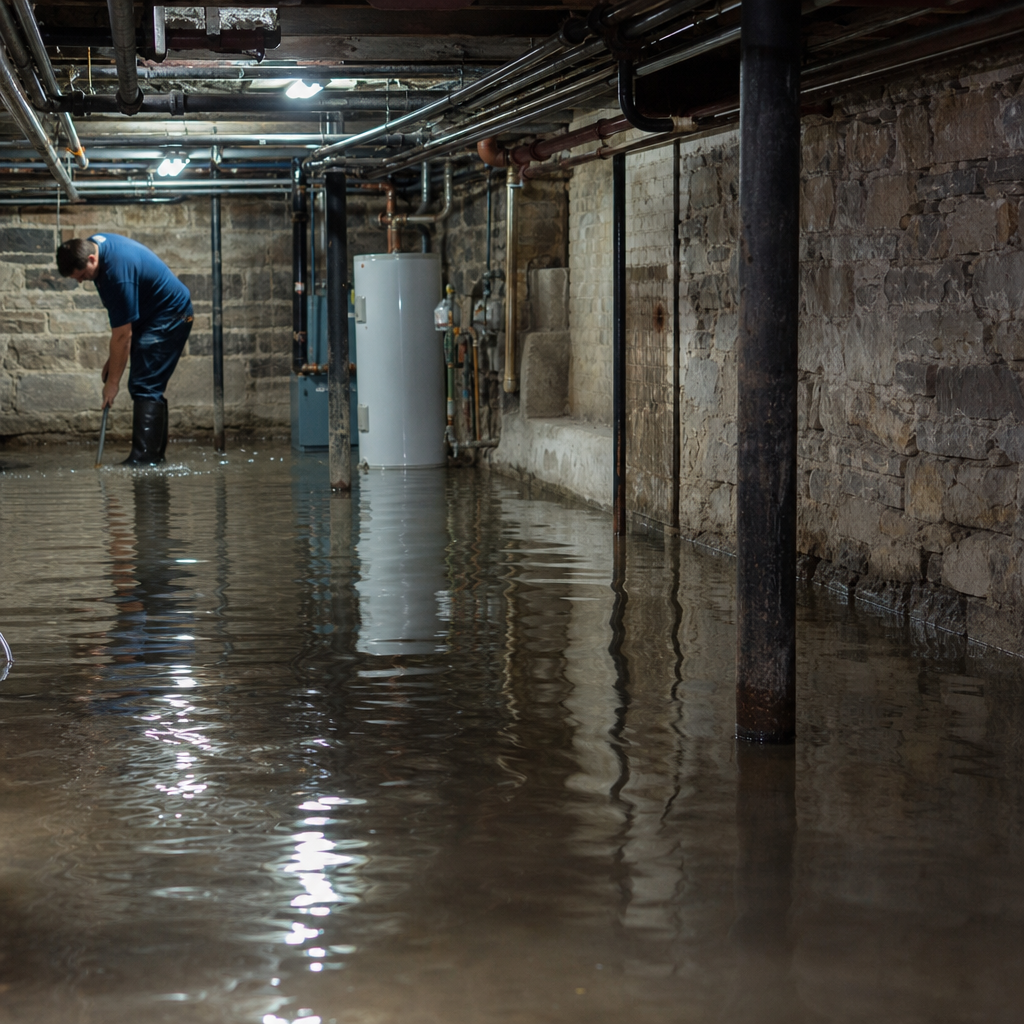
High-pressure pipe bursts release massive amounts of water in minutes. When a pressurized riser line splits on an upper floor, water cascades straight down utility runs, soaking ceilings, electrical boxes, and flooring across multiple floors below.
Managing High-Pressure Pipe Failures
Freezing cold snaps and old plumbing infrastructure put building pipe networks under extreme stress. Burst pipe claims represent some of the most expensive property losses in dense neighborhoods. Immediate shutoff and rapid extraction stabilize the base mitigation cost before water spreads outward into neighboring apartments.
Preventing Inter-Floor Structural Collapses
Saturated plaster ceilings grow heavy quickly, creating immediate collapse risks for anyone below. Experienced crews, such as those at Wade’s Restoration, locate hidden pooling using thermal imaging cameras, install controlled drain points to relieve water weight, and dry interstitial ceiling cavities with injected warm, dry air.
Basement Flooding and Below-Grade Water Intrusion
Below-grade water intrusion requires specialized extraction equipment because concrete slabs, stone foundations, and masonry walls hold water inside microscopic pores. Surface air movement is not enough; commercial desiccant dehumidifiers are necessary to pull bound moisture out of dense subterranean masonry.
Sump Pump Failures and Groundwater Ingress
Basements and sub-level storage facilities face hydrostatic pressure from rising water tables during heavy storms. When mechanical sump pumps trip or lose power, water pools around structural footings. Pumping this water out promptly protects foundation footings and utility rooms from long-term rot.
Drying Concrete Subfloors and Storage Areas
Drying dense concrete requires lowering the ambient vapor pressure in the room so the slab can release its moisture. Technicians position desiccant dehumidification systems to draw dampness out of concrete pads, preventing future flooring adhesion failures, persistent musty smells, and masonry deterioration.
Roof Leaks and Severe Storm Damage
Wind-driven rain and damaged roof membranes allow water to soak attic insulation and pond on top of upper-floor drywall ceilings. Stopping the intrusion at the building envelope is the first step in keeping water from running down interior partition walls.
Emergency Tarping and Water Diversion
When roofing membranes fail during a storm, emergency response crews install heavy-duty temporary tarps and set up drainage lines to divert incoming water away from exposed framing, stabilizing the property until permanent roof repairs can be completed.
Ceiling Collapse Prevention
Water sitting above finished gypsum or plaster creates hazardous weak spots. Mitigation crews systematically relieve this overhead pressure:
- Scanning ceilings with non-destructive infrared cameras to pinpoint trapped water pools.
- Drilling targeted weep holes to drain trapped water into collection bins under controlled conditions.
- Taking down unsalvageable, sagging drywall sections to protect flooring underneath and speed up drying.
Sewage Backups in Multi-Unit Commercial and Residential Properties
Need water damage restoration cost per square foot?
We’re available now - call for a fast, free estimate.
A main drain backup in a commercial building or residential complex creates an immediate health concern and stops normal operations. When commercial sewer lines fail, black water backs up into ground-floor lobbies, tenant bathrooms, and utility areas, requiring fast containment to keep downtime minimal.
Main Line Clogs and Drain Overflows
Heavy drain clogs push wastewater out of lowest-level fixtures first. Rapid extraction and containment keep the damage confined to entry points, preventing biohazards from seeping beneath adjoining commercial tenant spaces.
Property Compliance and Documentation
Category 3 sewage losses require verifiable sanitization clearance before occupants can return safely. Technicians document the entire remediation process, providing ATP swab test results and itemized drying records that satisfy both municipal health codes and insurance requirements.
Mold After Water Damage: Secondary Damage Risks
Mold growth is the direct result of incomplete or delayed drying. If wet materials are not brought back down to standard equilibrium moisture content within 48 hours, active colonies start developing inside structural cavities and under flooring.
The 48-Hour Critical Window
Fungal spores require moisture, oxygen, and an organic food source like drywall paper or wood framing. Removing the moisture within the first two days halts the biological clock, keeping your project in the category of standard drying rather than costly environmental remediation.
Hidden Moisture Behind Plaster and Millwork
Plaster walls and custom cabinetry often look dry on the outside while remaining wet behind the surface. Restoration technicians, such as the specialists at Wade’s Restoration, use deep-probe moisture meters and thermal imaging to confirm that internal framing reaches standard dry targets before equipment is removed.
Parts and Components Repaired During Restoration
Full-service restoration involves repairing structural components, finishes, and mechanical assemblies back to pre-loss condition once drying is complete.
Drywall, Ceilings, and Plaster
Restoration includes clean flood cuts, sheetrock replacement, tape-and-spackle finishing, and painting. In older properties, technicians repair plaster and lath systems, preserving original architectural details wherever structurally possible.
Hardwood, Laminate, Subflooring, and Joists
Using specialty floor-mat extraction systems, hardwood floors can often be dried flat in place without tearing them out. Delaminated composite flooring is removed, and structural subfloors and load-bearing joists are dried, treated, and reinforced.
Cabinets, Insulation, and HVAC Ductwork
Trapped moisture behind built-in vanities and custom millwork is pulled using targeted cavity-drying injectidry systems. Saturated fiberglass or cellulose insulation is stripped out, and affected ductwork is sanitized and dried to protect overall indoor air quality.
What Does Water Damage Restoration Cost Per Square Foot?
Baseline water mitigation costs run from $3.00 to $7.50 per square foot, while structural reconstruction runs separately at roughly $20 to $37 per square foot. In multi-story buildings, project pricing reflects not just surface square feet, but the vertical distance water traveled, waste disposal requirements, and access logistics.
Mitigation and Reconstruction Cost Drivers
The primary pricing drivers that determine overall restoration expenses include:
- Water Sanitation Category: Category 1 clean water mitigation ranges from $3.00 to $4.00 per sq ft (average $3.50), Category 2 gray water ranges from $4.50 to $5.50 per sq ft (average $5.25), and Category 3 black water ranges from $7.00 to $7.50+ per sq ft (average $7.50).
- Mitigation vs. Reconstruction: Initial water extraction, drying, and structural stabilization range between $3.00 and $7.50 per square foot, while structural rebuilding of framing, drywall, and finishes runs from $20 to $37 per square foot.
- Building Access and Logistics: Freight elevator availability, building work-hour rules, and debris disposal pathways directly influence labor time.
- Vertical Water Travel: When water drops through multiple floors, each affected level requires independent containment, air scrubbing, and moisture checks.
Frequently Asked Questions About Water Damage Restoration Costs
How much does water damage restoration cost per square foot?
Mitigation and structural drying typically range from $3.00 to $7.50 per square foot. Clean water averages around $3.50 per sq ft ($3.00 to $4.00), gray water runs about $5.25 ($4.50 to $5.50), and black water averages $7.50 ($7.00 to $7.50+). Reconstruction and rebuilding of damaged finishes run separately at roughly $20 to $37 per square foot.
Does homeowners or commercial property insurance cover restoration costs?
Standard property policies generally cover water damage that is sudden and accidental, such as burst pipes, frozen lines, or appliance supply failures. Restoration teams like Wade’s Restoration document moisture readings, take detailed loss photos, and assist with claim documentation using industry-standard pricing schedules.
How quickly do restoration teams respond on-site?
Emergency response times vary by provider, but rapid dispatch is critical to begin extraction promptly, prevent moisture migration, and minimize secondary structural damage.
What qualifications should restoration technicians have?
Qualified restoration technicians typically hold industry certifications in water extraction, applied structural drying, and microbial remediation. They use calibrated thermal imaging and penetrating moisture meters to confirm that structural materials meet verified dry standards.
Need water damage restoration cost per square foot?
We’re available now - call for a fast, free estimate.
Sources
- Water Damage Insurance Claims Statistics (2026 Data) – consumeraffairs.com (2026)
Frequently Asked Questions
How is the exact square footage calculated when water travels behind walls or between floors?
Restoration specialists measure beyond visible surface water by using thermal imaging and deep-probe moisture meters to track moisture inside wall cavities and subflooring. Wade's Restoration conducts detailed on-site visual inspections and moisture mapping to deliver an upfront, accurate line-item estimate based on the entire affected structural footprint.
Can hardwood flooring and subfloors be saved to avoid the higher cost of reconstruction?
Yes, if extraction begins within the initial 24 to 48 hours, specialized floor-mat extraction systems can often dry hardwood and subfloors flat in place without tearing them out. Wade's Restoration deploys targeted industrial drying systems rapidly to preserve structural materials and keep total project expenses confined to basic mitigation pricing.
How long does the structural drying phase typically take before repairs can begin?
Commercial drying and moisture stabilization generally take three to five days depending on water category and structural density. Technicians from Wade's Restoration track daily ambient humidity and wood moisture levels to verify framing has reached certified dry targets before reconstruction starts or insurance files are finalized.
About the author
 |
Marcus Avery Marcus Avery is an IICRC-certified restoration specialist with over 12 years of experience in structural drying and water damage mitigation. Holding a B.S. in Construction Management from the Wentworth Institute of Technology, he frequently consults with property management firms in the tri-state area on emergency response planning. Marcus specializes in helping Midtown West property owners navigate complex water damage scenarios and detailed restoration cost analysis. |
Water damage, flood, or mold emergency?
We’re available now - call for a fast, free estimate.
Call Now - Free Estimate